Omega Speedmaster Effect: Three Collectors, Three Distinct Personalities



Opinions
Are There Too Many Watches?
Some days, it feels like there’s a firehose filled with new watch releases being cranked open. How can anybody keep up?

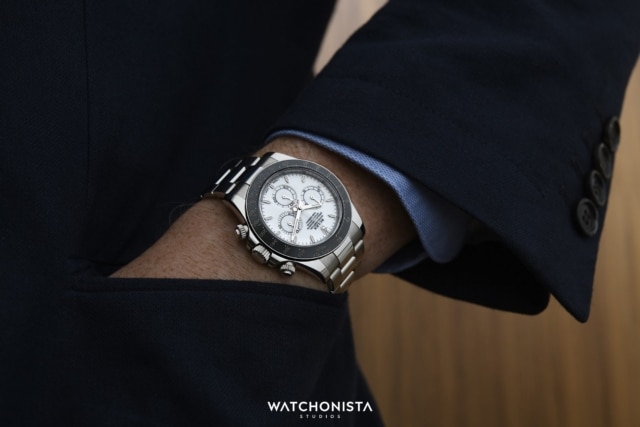
I love watches. I’m not as big a fan of email. So, when it started to feel like I was spending two hours every morning just reading press releases – not even responding, just reading – I stood up from my desk, shook my fist at the sky (or ceiling, technically), and shouted (wrote an email to the editors at Watchonista, technically): “THERE ARE TOO MANY WATCHES!”
I came up with the thesis for this op-ed before Watches and Wonders and the spring watch auctions. It was a simpler time when I was averaging about twenty timepiece-related emails a day. Of course, the volume of press releases feels like it’s been cranked up fourfold since then.
According to the new-release tracking by the Geneva-based website The Watch Pages, at least 906 new models debuted in 2025. And surely this survey is missing introductions from microbrands and obscure independents.
Let’s be clear here. I’m just focusing on new releases. That covers everything from limited editions of already established references to completely new novelties.
As a journalist, I’m frustrated because I want to give every new model a fair shake. But 906 watches is information overload. In fact, in the time it took me to write this paragraph, I just got three more emails about embargoed releases.
The Unobtanium Effect
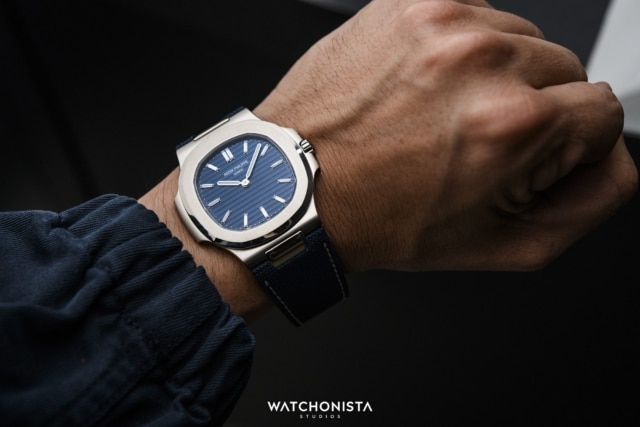
But from a collector’s perspective, it can feel as though scarcity, not abundance, is the problem. Many of the new releases we cover – especially in the luxury sphere – are limited releases. When something is almost impossible to acquire, it just seems to make collectors want it more.
Brands recognize this. There’s a long history of managed scarcity in luxury goods that we won’t get into here, but think of the waiting lists for Birkin bags, JAR jewelry, or Ferrari supercars.
In a 2020 article for Quill & Pad, collector Gary Getz examined managed scarcity in high-end horology, including how it transformed from a tool to reward longtime customers who have shown loyalty to the brand into unobtanium used to fuel the hypebeast: “Access to [a] brand’s highest complications was reserved for the loyal customers of the brand and by application only, and top customers…were sometimes granted the privilege of requesting unique pieces.”
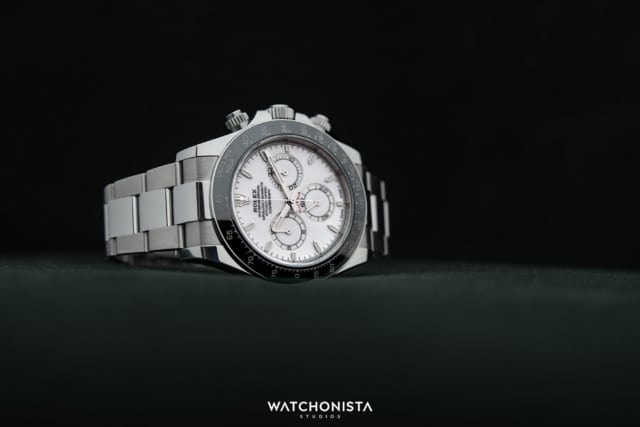
However, as Getz notes in his article, limited-edition watches are engineered to induce cravings in collectors: “Brands have contributed to the mentality of scarcity over the years by introducing steady streams of limited edition pieces; and while [some] brands…receive their fair share of criticism for breathlessly hyping the latest substantially-sized ‘limited’ runs of modestly tweaked pre-existing models, those watches do sell, at least well enough for their makers to continue repeating the practice.”
Then, starting in 2020, supply chain issues and global upheaval caused real scarcity, leading more brands to use limited production runs to keep collectors interested. This is where the effect of the K-Shaped economy kicks in – spending is rising at the top, holding steady on the value end, and hollowing out in the middle – and fashion and luxury brands are adjusting pricing and assortment as a strategy.
So, while the Maisons are producing fewer watches overall, they are actually releasing more models as limited editions to gin up demand.
The Dangers of Managed Scarcity
The Substack newsletter Pointless Complication examines the mechanics of high watchmaking – specifically, it looks at “what brands claim, what movements prove, what pricing exposes, and where collector belief begins to fail.” Recently, its pseudonymous creator, Velociphile, posted an article called “What the Watch Industry Cannot Admit,” which examines the macroeconomics of this strategy.
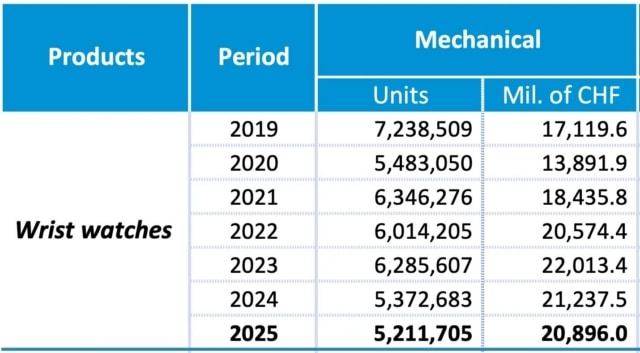
In this article, he cites figures from the Federation of the Swiss Watch Industry showing the number of “Swiss Made” mechanical watches manufactured versus total sales in Swiss francs.
As you can see in the chart above, in 2019, 7,238,509 units were produced, generating CHF 17,119,600 in sales. However, in 2025, despite producing 2 million fewer units (5,211,705), total sales increased by over 3 million Swiss francs (CHF 20,896,000). According to Velocophile’s analysis, while a “less is more” strategy may seem appealing on a spreadsheet, focusing on managed scarcity to fix the watch industry’s woes could prove problematic in the long term.
“This is visible in the swollen middle market and product calendar of almost any major brand: a steady procession of coloured dials, archive references, and ‘icons’ that seem to have been declared rather than earned,” writes Velocophile. “The issue is not that these watches are necessarily bad. Many are competent, and some are excellent, but the problem is that competence at a higher price is not the same as desire.”
The article in Pointless Complication has been widely circulated in the watch industry because of its take on the current state of luxury watches.
One takeaway is that there are not too many watches, but rather too many watches in the mid-to-upper price ranges are priced too high: “The problem is not that a 20,000CHF watch is expensive. The problem is that too many 20,000CHF watches cannot clearly explain why they matter beyond the fact that the brand says they do.”
Taking It One Brand at a Time
I have now received two more press releases in my inbox. I can’t really give away the embargoed info, but it’s safe to say that four of the five press releases I received since sitting down to write this article are about established references in new case materials. The fifth is the announcement of a GMT version of an existing model.
That said, earlier this week I attended two collector events, one for Rado and one for Longines. The Rado presentation was a celebration of 40 years of high-tech ceramic, featuring a 40th-anniversary edition of the Integral. Longines was launching its new Longines HydroConquest watch collection, including a limited edition commemorating the Glasgow 2026 Commonwealth Games.
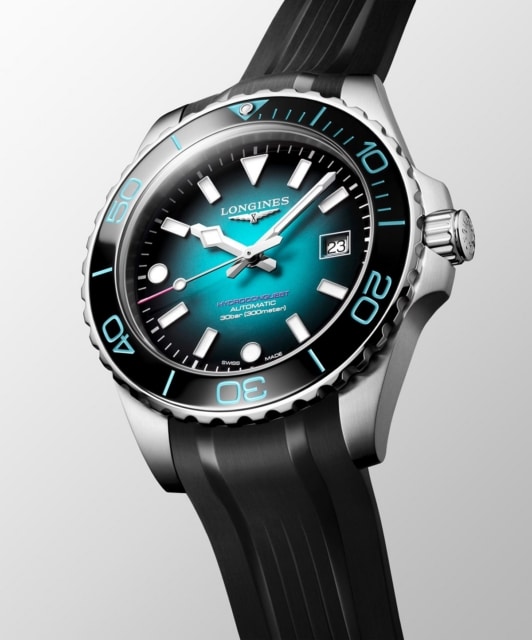
I used this opportunity to survey the collectors in attendance to see whether they shared my concern that there were too many watches. Interestingly, they did not.
Because they were focused on collecting only a handful of brands, they were able to filter out the noise of new releases. In fact, these in-person events also gave me hope for the middle market (and, perhaps, my sanity), as they were kind of safe spaces from the hype surrounding the Audemars Piguet x Swatch and Baltic x SpaceOne collaborations that dominated the online watch community earlier this month.