All Hail: Brew Celebrates New York City at the Windup Watch Fair with a Tribute to the Iconic Checkered Taxi






A Closer Look
Time on a Grander Scale: A Closer Look at Patek Philippe’s Astounding Celestial Ref. 6105G
Phase of the Moon. Date. And now, sunrise and sunset indications on a hyper-accurate field of the sky. The fabled watchmaker’s first wristwatch to offer this extraordinary combination of functions is redefining what can be achieved with a “celestial watch.”

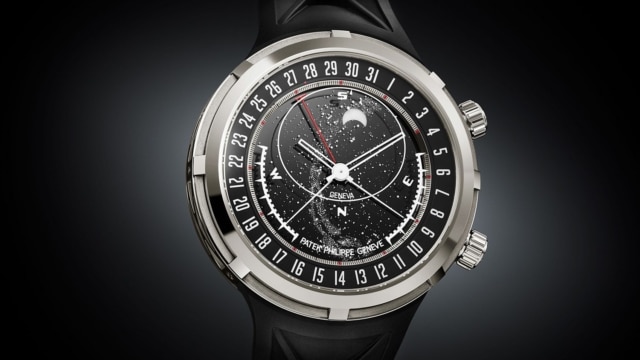
I was a tad confused when I first encountered the Ref. 6105G-001 when Patek Philippe revealed it at the most recent Watches and Wonders show. However, at Patek Philippe’s annual press “summer garden party” in New York City recently, I had all my questions answered, and by a watchmaker. Still, I’m not positive I’ve completely wrapped my head around this watch’s fascinating clockwork universe.
What I can say is, after you get used to working with it, the Patek Philippe Ref. 6105G-001’s (dubbed the “Celestial Sunrise Sunset”) large representation of the sky and moon on the dial and (count ‘em) five hands deliver a new level of temporal orientation that more than makes up for any learning curve needed to fully appreciate what the watch is telling you.
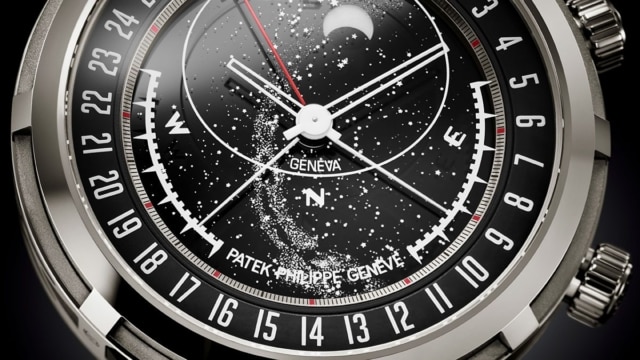
So, the underplayed central hour and minute hands (adjustable from the 4:00 crown on the watch’s 47mm white gold case) do not run along a dedicated chapter ring to present the “civil” time (the header picture shows a traditional watch-photo time of 10:10. Those white gold hands are skeletonized, to boot.
This presentation tends to minimize that time-telling function, admittedly, but there is so much more celestial information to explore on this beautiful timepiece.
Suns Signs
To offer the brand’s first grand complication that displays the changing times of sunrise and sunset, indicated by the dial’s two thinnest white hands, designers required a five-year development process and six patent applications to reach the milestone.
The two hands run along an east/west labeled semicircular gauge (so, sunrise for the day on the east side, sunset on the west side, naturally). Moreover, the mechanics of the timepiece’s new function automatically adjust those time indications to correct for summer and winter time.
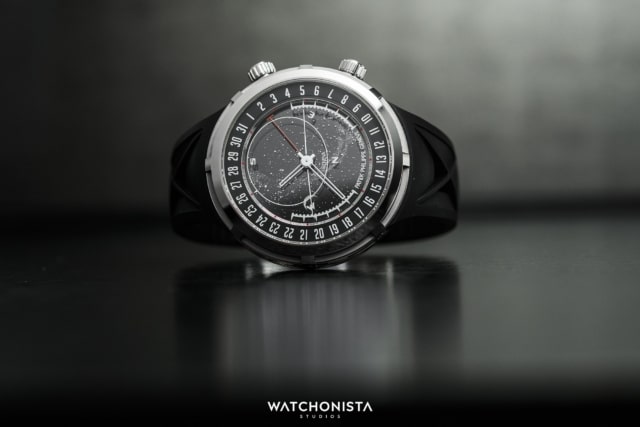
The sunrise/sunset functions are keyed to Geneva, which might sound like a limitation at first. However, this specialization creates an apt spiritual connection to the center of the watch world that borders on the poetic. That narrative connection to Geneva is also picked up in the watch’s impressive sky/moon dial display.
Besides, assuming it were even possible, making this function location-adjustable (or even made-to-order) would require an extraordinary amount of additional development.
Geneva Sky
Taking its lead from previous Patek Philippe Celestial timepieces, the Ref. 6105G-001’s incredibly complex dial presents the night sky as viewed from Geneva (well, here, there is some more universality as the sky scape is also accurate for any Northern Hemisphere locations at the same approximate latitude).
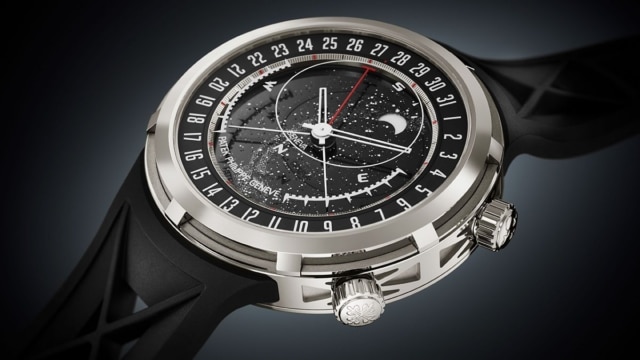
The dial also functions as a kind of “mobile star chart” that reproduces the movement of the stars, the moon’s angular motion, and the moon’s phases. This is thanks to an ingenious display system that utilizes the interplay of three overlapping transparent discs, which allows the celestial movements to play out continuously in real time on your wrist.
The self-winding 240 C LU CL LCSO movement’s rotational mechanisms take into account sidereal time (referenced star movements – Sirius is commonly used – that cycle at a 23-hour, 56-minute, 4-second day across a fixed meridian), lunar days (the period of the moon’s consecutive passage past a fixed point twice, which calculates out to 24 hours, 50 minutes, and 28 seconds), and lunar month timing (the time elapsed between two full moons, which averages out to 29 days, 12 hours, 44 minutes, 2 seconds).

This exacting approach creates one of the most accurate, true representations of a sky you’ll find on any wrist (the 2:00 crown is for adjustments to the celestial functions). For clarity, the circle on top of the dial shows the horizon-visible portion of the sky for the current time and date, with N, S, E, and W indicators for orientation.

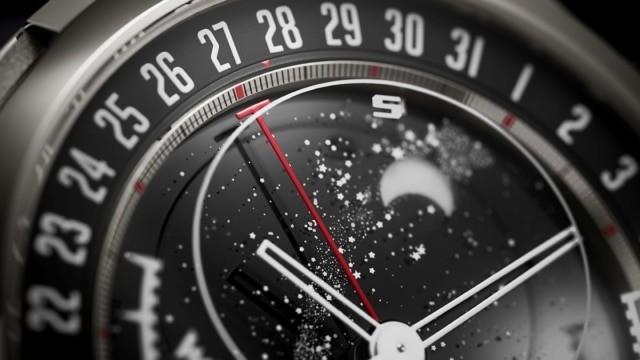
The red flat-tipped hand indicates the date across the outer numerical ring. Ingeniously, by orienting that ring with the “1” numeral away from a typical noon-top position, the gauge also doubles as the time indicator for the thin sunrise/sunset hands using the interval from 5 (or 5:00 a.m.) to 23 (or 11:00 p.m.) on the circle.
Pricing & Availability
An integrated textured black composite strap just adds to this masterpiece’s profound technicality. Still, considering this timepiece comes right up to the line as qualifying as an extremely accurate cosmological instrument, it carries a sky-high price of $437,610.
While no production limitations were indicated by Patek Philippe at press time, the Celestial Sunrise Sunset Ref. 6105G-001 will certainly be a “shooting star” rarity for avid collectors of the Geneva-based watchmaker.
For more information, check out the Patek Philippe website.