A. Lange & Söhne’s New Datograph Perpetual Arrives in Style


The 6239 S/S ‘Doctor Love’
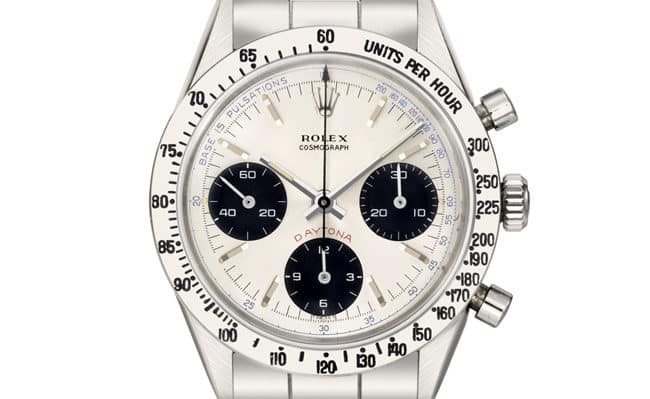
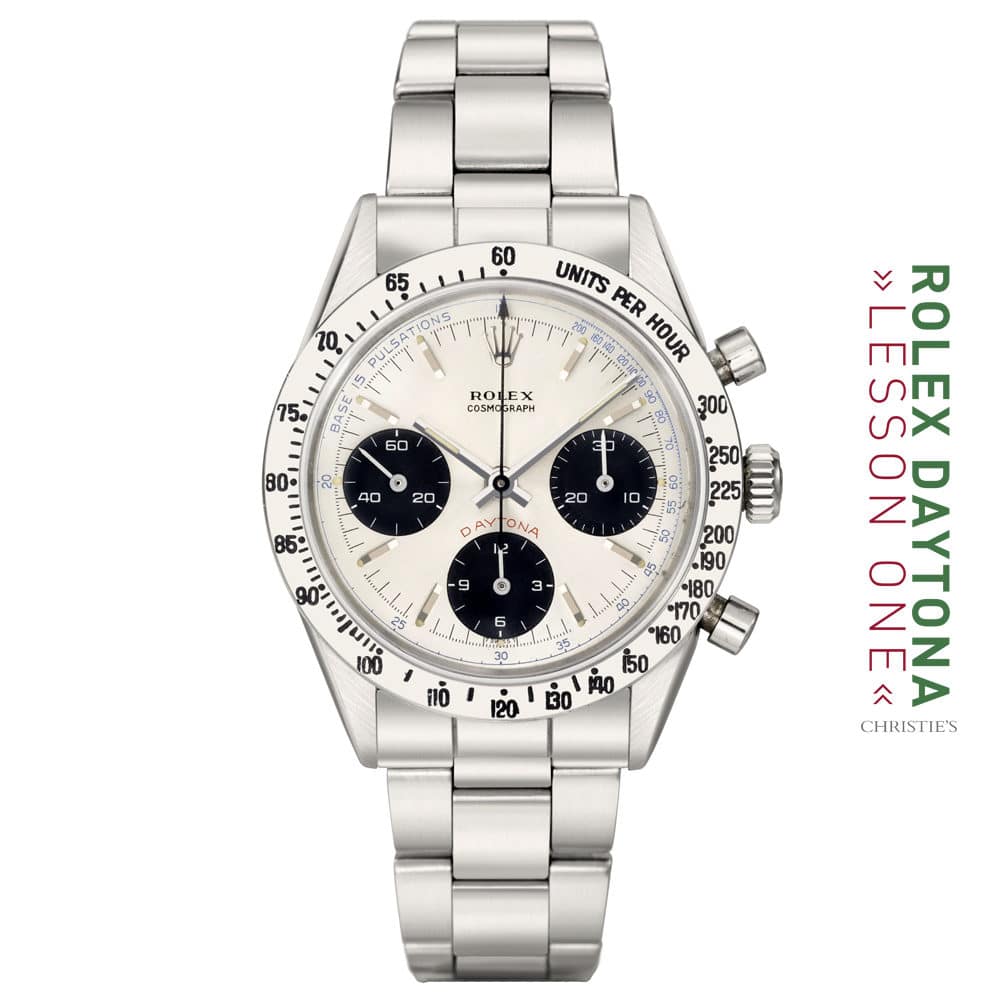
ROLEX. AN EXTREMELY RARE AND IMPORTANT STAINLESS STEEL CHRONOGRAPH WRISTWATCH WITH PULSATION DIAL AND BRACELET
SIGNED ROLEX, COSMOGRAPH, DAYTONA, REF. 6239, CASE NO. 1’695’328, MANUFACTURED IN 1967
Cal. 722-1 mechanical lever movement, 17 jewels, silvered brushed dial, applied baton numerals with luminous accents, luminous hands, outer ffths of a second divisions and blue scale calibrated for 15 pulsations, three black engine-turned subsidiary dials for constant seconds, 30 minutes and 12 hours registers, tonneau-shaped water-resistant-type case, blank bezel calibrated for 300 units, screw back, screw down crown, two round chronograph buttons in the band, stainless steel Rolex Oyster bracelet, case, dial and movement signed.
Irony is often the protagonist in vintage watch collecting, where rarity is one of the main features that infuence the desirability of a timepiece. A model too far ahead of its time may not be appreciated by the public when frst commercially available. As a result there is a dramatic reduction in the models produced and thus an increase in its desirability years later, when its true beauty is eventually recognised.
There are instances where this effect is so remarkable that the number of pieces produced is so small that it can be counted on two hands. This is the case for the “pulsometer” scale Daytona. At a time when even the standard chronograph is regarded with suspicion by the mainstream public, a model so specifc, and targeted to such a limited segment of the market, went completely unnoticed. As a matter of fact, maybe only ten of these pearls are historically referenced.
The ‘pulsometre’ scale is a function that is dedicated to medical practitioners. It enables one to calculate the heartbeat based on the number indicated on the dial.
Practically speaking, one has to start the chronograph function at the frst heartbeat and to stop it at the last, in this instance the 15th. The chronograph second hand will then indicate the number of beats per minute directly onto the dial’s scale. The advantage of this function is to avoid counting the beats for an entire minute, thus saving time and effort.
As it happens, a 20 beat measurement would certainly be more precise, but it would also take more time. Conversely, a 10 beat timing would be faster but less precise. Therefore, the ‘Base 15’ represents a good compromise.
The presence of the pulsometre scale prompted Rolex to make several adjustments with a fnal result that is simply superb. The hour markers have been moved closer to the centre of the watch resulting in a more “compact” layout. The dial is modifed in such a way that the fnal effect is more aesthetically pleasing. Also, the chromatic scheme of the timepiece is completely different. For example, the medical scale is printed in an innovative bright blue tone, which allows for a perfect legibility despite the smaller dimensions of the numbers.
As mentioned previously, the medical Daytona is undoubtedly one of the rarest chronographs ever. However, what is even more remarkable is that, of the few medical Daytonas known, only two have the red Daytona designation. One is the watch offered here.
In addition, the watch presents further modifcations compared to other similar examples. The black minute scale has been completely redesigned and now presents gaps between the hour markers. Also, the “T SWISS T” designation under the hour totalizer is smaller than on other Cosmograph models. On the other hand, other distinctive features concerning the ultra-rare medical dials remain unchanged, such as the external blue pulsometre scale graduated for 15 beats and the markers positioned backwards in respect to their axis.
Courtesy of Christie's


50 EXCEPTIONAL EXAMPLES OF THE WORLD’S MOST CELEBRATED CHRONOGRAPH WRISTWATCH AUCTION
GENEVA – 10 NOVEMBER 2013
LOT 7
ESTIMATE PRICE: SFr.120,000-240,000
PRICE REALIZED: SFr.761,000
Specs
Functions
Hours, Minutes, Seconds, Chronograph
Movement
Manufactured, Swiss Made
Case
Stainless steel, Brushed & Polished, 36.50mm (diameter)
Buckle
Deployment Buckle
Strap
Stainless steel
Year
1967
Reference number
Ref. 6239