MB&F LM1 EVO: Updates Tempt Me to Put My Money Where My Mouth Is






Novelties
The New Omega Constellation Observatory: The First Two-Hand Watch with Master Chronometer Certification
The first two-hand watch to achieve Master Chronometer certification marks a technical breakthrough for Omega.


The new Omega Constellation Observatory is more than an evolution of a classic line; it represents a genuine shift in how precision is measured. For the first time, a two-handed watch (displaying only hours and minutes) has achieved full Master Chronometer certification.
This milestone is enabled by a groundbreaking acoustic testing method developed by the Laboratoire de Précision, which removes the long-standing need for a seconds hand in precision testing. The collection blends heritage design with modern engineering, delivering both aesthetic refinement and technical excellence.
Key Highlights
• First two-hand watch to achieve Master Chronometer certification
• Acoustic testing replaces traditional seconds-hand measurement
• Dual Metric Technology monitors performance continuously over 25 days
• Two new in-house calibres: 8914 and 8915
• Vintage Constellation design meets modern materials and finishes
A Legacy of Precision, Reimagined
Since 1952, the Constellation collection has symbolized Omega’s pursuit of certified precision. Every mechanical Constellation has historically been a chronometer, reinforcing the line’s technical credibility.
The Observatory Collection builds on this heritage while introducing a forward-looking approach. Its design references early Constellation models, particularly the pie-pan dial and observatory medallion, while its engineering pushes the boundaries of modern certification.

This release connects to a broader timeline of innovation, from the Centenary chronometer of 1948 to the Co‑Axial escapement and anti-magnetic movements of the 21st century. Now, the Observatory adds a new chapter: precision without a visual seconds hand.
A New Era of Testing: The Laboratoire de Précision
At the heart of this innovation is the Laboratoire de Précision, an independent certification body accredited to test both Chronometer and Master Chronometer standards. Replacing traditional optical observation of the seconds hand, which offered only limited daily data, the new approach uses a wireless acoustic system that records every tick in real time.

Powered by Dual Metric Technology, it continuously tracks factors such as frequency stability, temperature variation, magnetic resistance, positional deviation, and atmospheric pressure, building a detailed 25-day performance profile that reveals not just precision, but when and how variations occur.
New Master Chronometer Movements
The Constellation Observatory collection unveils two newly developed movements: the Calibre 8915, featured in the Grand Luxe and Luxe models, and the Calibre 8914, designed for the standard versions crafted in O-MEGASTEEL.
Both feature a skeletonized rotor with refined finishing, polished bevels, and a rounded rotor edge. Each is Master Chronometer certified and anti-magnetic.
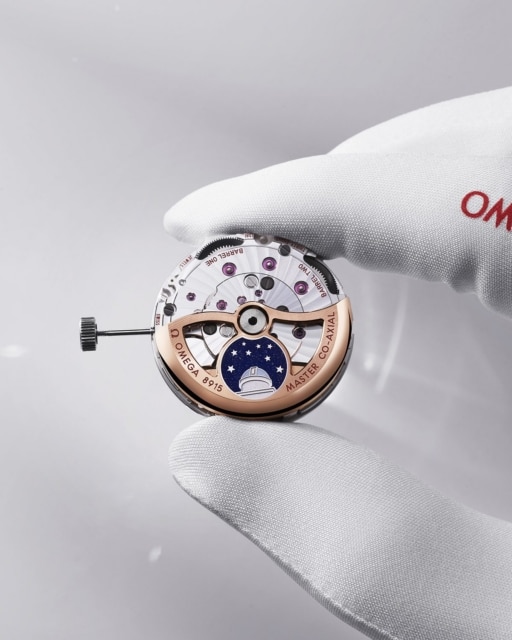
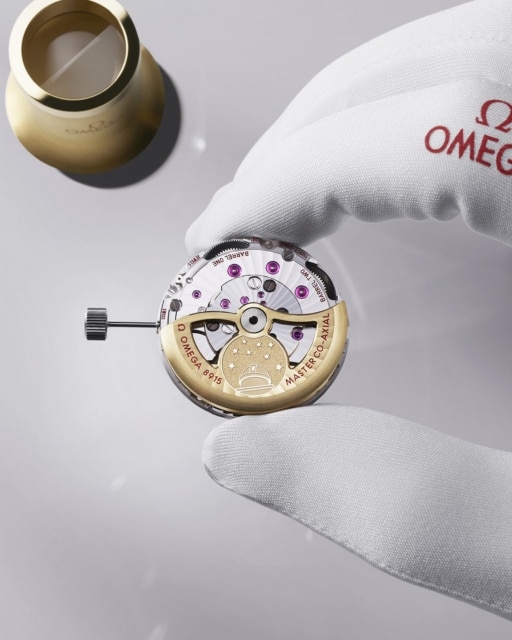

Here are the highlights of each execution:
• 8915 Grand Luxe: 18K Sedna Gold rotor with an intricate Observatory medallion, aventurine glass, and enamel detailing
• 8915 Luxe: Introduces 18K Moonshine Gold rotor and balance bridge
• 8914 Standard: Rhodium-plated version for steel models
All calibres maintain the same performance standards, with varying degrees of decorative craftsmanship.
Dial and Design: A Return to Constellation Codes
The dodecagonal pie-pan dial reconnects with mid-century roots, enhanced with guilloché finishing.
Design elements include:
• Applied Constellation star at 6 o’clock
• Faceted dauphine hands
• Kite-shaped hour markers
• Observatory medallion on the caseback

Without a seconds hand, the dial is cleaner, more symmetrical, and easier to read, while retaining historical authenticity.
Case and Materials: Innovation Meets Craft
The 39.4 mm case is offered in both precious metals and Omega’s proprietary O-MEGASTEEL. The gold versions – Sedna, Moonshine, and Canopus Gold – feature a fully integrated design, with cases, dials, and movements sharing the same harmonious finish.
A standout is the platinum-gold edition, which combines multiple proprietary alloys within a single watch – an unprecedented achievement for Omega.

Steel models use O-MEGASTEEL, valued for its hardness and brilliance, and introduce a black ceramic pie-pan dial despite its complex dodecagonal shape, maintaining a balance between innovation and the collection’s classic design codes.

Craftsmanship and Significance
For decades, a second hand was considered essential for both timekeeping and certification, yet the Constellation Observatory challenges this idea by redefining precision. Using an acoustic testing method and Dual Metric Technology, it continuously monitors performance over 25 days, tracking real-time variations in frequency, temperature, magnetism, position, and atmospheric conditions.

At the same time, the watch remains rooted in tradition. Its design language, refined finishing, observatory medallion, and historical references reinforce the Constellation’s heritage.
Together, these elements create a balance between technical innovation and classic elegance.
Price & Availability
The collection is available through Omega boutiques and authorized retailers, with pricing varying according to materials and configurations—from stainless steel models to high-end precious-metal editions.
Here are the prices by reference:
• Ref. 140.13.39.21.02.001 (O-MEGASTEEL) – CHF 9,200
• Ref. 140.13.39.21.03.001 (O-MEGASTEEL) – CHF 9,200
• Ref. 140.13.39.21.10.001 (O-MEGASTEEL) – CHF 9,200
• Ref. 140.13.39.21.01.001 (O-MEGASTEEL) – CHF 10,300
• Ref. 140.50.39.21.99.001 (Moonshine™ Gold ) – CHF 49,700
• Ref. 140.53.39.21.99.001 (Moonshine™ Gold ) – CHF 31,900
• Ref. 140.53.39.21.99.002 (Sedna™ Gold) – CHF 31,900
• Ref. 140.53.39.21.99.004 (Canopus Gold™) – CHF 37,100
• Ref. 140.93.39.21.99.001 (Platinum‑gold) – CHF 48,600
For more details, visit the official Omega website.
FAQ by Watchonista
What movement does the Omega Constellation Observatory use?
It uses the new in-house Calibre 8914 and 8915, both Master Chronometer certified.
Is the Constellation Observatory a limited edition?
No, it is part of a permanent collection with multiple references.
What makes this watch unique?
It is the first two-hand watch ever to achieve Master Chronometer certification thanks to a new acoustic testing method.