MB&F LM1 EVO: Updates Tempt Me to Put My Money Where My Mouth Is





Novelties, Watches and Wonders Geneva 2026
The IWC Pilot’s Venturer Vertical Drive Presents a New Ergonomic Technical Frontier
There are many groundbreaking technical innovations debuting at Watches and Wonders this year, but how many will be cutting-edge functional tool watch tech developed specifically to address the needs of timekeeping during manned spaceflight and space living?

The story of “watches in space” has largely centered on creating robust timepieces that can survive the extreme conditions of gravitational forces (and lack thereof), temperature, vibration, thrust, and the many other overall demands of going into space and returning safely.
Well, prepare for a paradigm shift because IWC’s debut of the Pilot’s Venturer Vertical Drive in Geneva, developed in partnership with entrepreneurial aerospace company Vast, offers a more personal, ergonomic approach to the impending new realities of time‑telling in space, namely aboard space stations. The watch has successfully met all testing criteria for Haven‑1’s spaceflight environments and crew usage, earning official spaceflight certification from Vast. Haven‑1 is scheduled to launch next year as the world’s first commercial space station. The watch's design also anticipates hypothetical use in future scenarios like lunar and exo‑planetary colony environments.
“When our engineering division XPL developed the Pilot’s Venturer Vertical Drive, they did not simply adapt an existing watch design for use in space,” said IWC CEO Chris Grainger-Herr. “Every single detail of this watch has been single-mindedly optimized for the unique requirements of human spaceflight and timekeeping in space.”
Sounds interesting, right? Let’s check it out.
Out There
With the idea that the lion’s share of ongoing space activities will be conducted by explorers wearing gloved space suits, all of the Pilot’s Venturer Vertical Drive’s functions are managed by a patent-pending rotating bezel system (so, no crown).
Bezel movement is transmitted to the movement with an efficient clutch system dubbed the “Vertical Drive,” hence the watch’s moniker. Moreover, while an oscillating mass winds the watch in the everyday presence of actual gravity, turning the bezel counterclockwise fills the fuel tank when you are lost in space (or just want to have some fantasy wrist-winding fun).
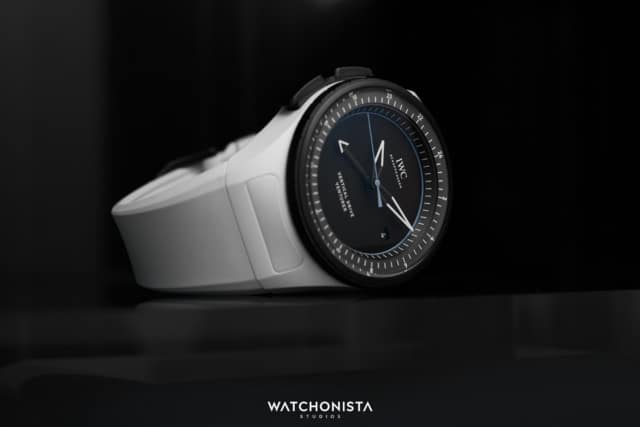
In addition, there is an easy-to-operate rocker switch on the left side of the case that allows the wearer to toggle between various functions, from winding to setting home time zone to setting mission time zone.
A Wrist Spaceship
Of course, this innovative IWC-manufactured 32722 automatic movement (which carries a 120-hour power reserve and 10 bar “splashdown” water resistance, BTW) requires an equally forward-looking space vessel to travel in.
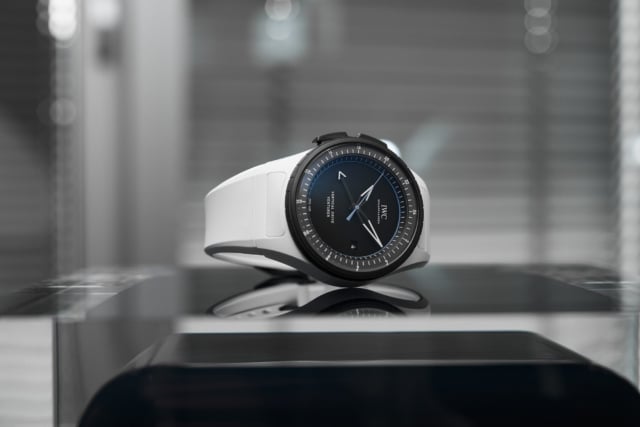
Lightweight, durable white zirconium oxide ceramic and IWC-proprietary Ceratanium construction provide the primary next-gen materials for the Pilot’s Venturer Vertical Drive. Furthermore, the look is simple black-and-white (with some blue detailing) and artfully minimalist, establishing a new mode of design futurism that doesn’t lean into that term with any sense of retro-space-age-iness.
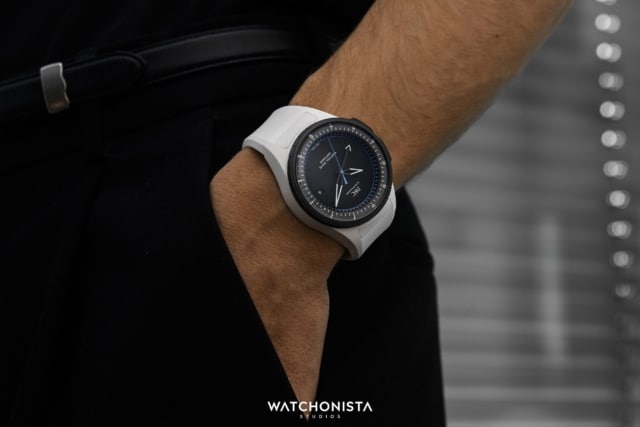
The 44.3mm case frames a matte black dial reduced to its anti-reflective essentials: Mission reference time (think second time zone, which, in space, would be GMT) is indicated by green-lumed central hour and minute hands, with an elongated third hour hand indicating home time. All in appropriately mil-spec, 24-hour format with minimal gauging on the outer dial flange.
A clean-font date window rides at 3 o’clock, but aside from the blue central dial gauge ring, blue seconds hands, and some subtle badging and gauging, that’s refreshingly it. The black “horns” of the rocker selector on the case’s left side only serve to add a dash of sleek technicality to this minimalist execution.
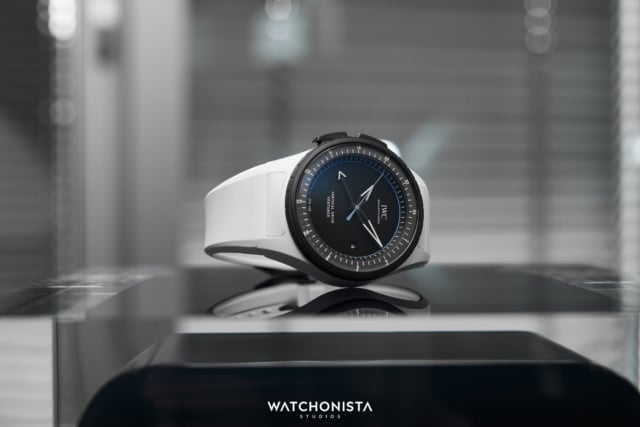
This stripped-down design wildly succeeds both in terms of sheer clarity and legibility and, in concert with a white, tapered, raised-detail FKM rubber strap, in looking like a “new” space-age-appropriate watch of the future.
Expert Testing
Development partner Vast played a hefty role in product testing, leading to the watch’s certification for its planned Haven-1 space station project. “It was crucial for us to put the final watch into the experienced hands of real space professionals. After undergoing rigorous testing by our partner, Vast, the Pilot’s Venturer Vertical Drive is the first IWC watch that has received certification for spaceflight,” explained Grainger-Herr.
Thus, the material tolerances of this timepiece are, across the board, very impressive: The new Vertical Drive scheme is designed to withstand blast-off forces up to 4g, the vacuum of space for EVAs (extra-vehicular activities), and temperature variations from 100 degrees to -150 degrees Centigrade.
The white zirconium oxide ceramic case has a Vickers hardness rating that is second only to diamond, and the IWC-developed Ceratanium rotating bezel and case back combine the lightness of titanium with the scratch resistance of ceramic.
“IWC’s dedication to engineering excellence, delivering uncompromising accuracy, reliability, and astronaut-focused design, aligns perfectly with Vast’s human-centric approach to developing Haven-1,” Vast CEO Max Haot shared. “We’re thrilled to see this tool watch go from design and testing to launch.”
The Countdown
Perhaps it is the promise of long-term space travel that this new piece embodies, but it is hard to think of IWC’s new Pilot’s Venturer Vertical Drive as anything but a show-stopping star of the Geneva show. Plus, any astronaut worth their suit (or any space fan) will certainly appreciate that IWC has firmly tagged this innovative timepiece as a “Pilot’s” watch.
For more information, including pricing and availability, check out the IWC website.