Omega Speedmaster Effect: Three Collectors, Three Distinct Personalities





Novelties, Watches and Wonders Geneva 2026
Got Rocks? Semi-Precious Stones Are at the Heart of Piaget’s Watches and Wonders Offerings
The brand comes out swinging with new sautoirs, Sixties on leather straps, and stone-dialed Polo 79s.

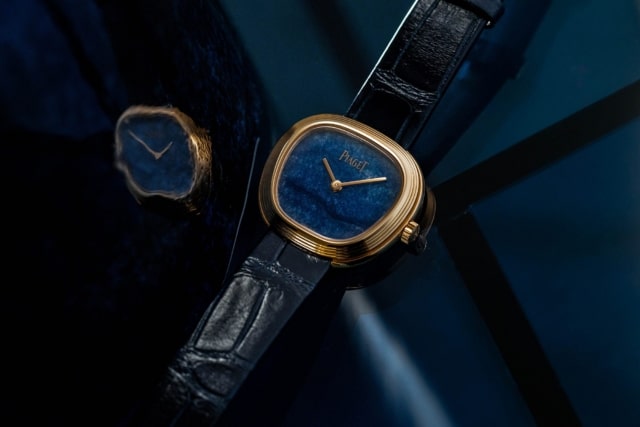
This year at Watches and Wonders, Piaget is having a rock star moment.
Using semi-precious stones, gold chains, and sumptuous shapes and textures, the brand introduced new Swinging Pebbles Sautoirs, shapeshifting, stone-faced updates to the Sixtie collection, and a sodalite-dialed Polo 67.
Piaget has already carved itself a place on the Mount Rushmore of semi-precious dial makers, but these new launches put a new emphasis on movement – and not just the mechanical kind. Let’s take a closer look.
Piaget Swinging Pebbles
The word “movement” has many meanings. French critic André Malraux observed that handmade objects outlive people. They reflect the need to record experience, values, and patterns of thought that can mark an era, age, or epoch. For Piaget, the late 1960s and early ‘70s were a crucial time. For starters, the brand introduced its 21st Century Collection of cuff watches and sautoirs in 1969; it truly gave new meaning to the word “movement.”
“Sautoir” is a French term for a long necklace with an ornament, such as a tassel or other ornament, hanging from the bottom. This type of necklace has been around for centuries, but really took off in the twentieth century, owing to the freedom of movement created by women’s dress silhouettes becoming less corseted.
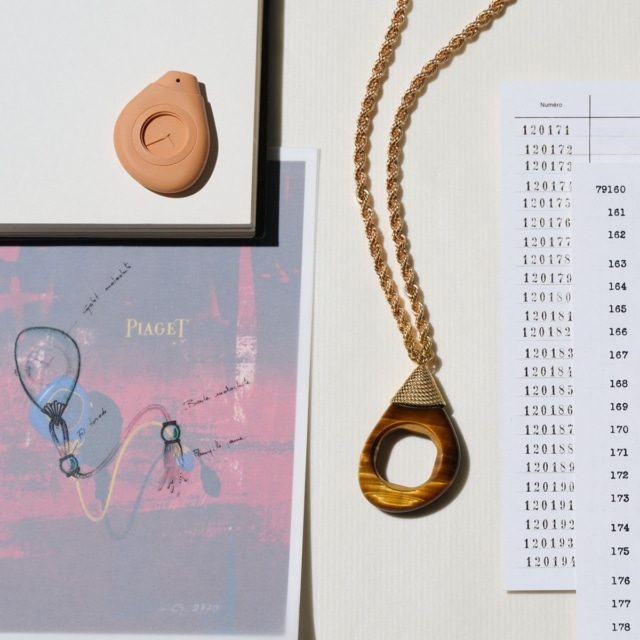
As much as the sautoir symbolized the glamorous ladies of the Gilded Age, the Roaring Twenties, and the Swinging Sixties, at Watches and Wonders 2025, Piaget expanded its pendant watch collection with transformable timepieces for the modern age with colorful stones (ruby-root, spinel, white opal, etc.) that could be worn on a leather bracelet or from a hand-woven gold chain.
Piaget’s heritage of goldsmithing, gem-setting, and daring designs came to epitomize an era of revolution in watchmaking. Thus, set with colorful stones (ruby-root, spinel, white opal, etc.), the sautoirs from 2025 were stunning examples of high-jewelry craftsmanship, but they are also adaptable. They are designed to be worn on a leather bracelet or hanging from fluid gold chains.
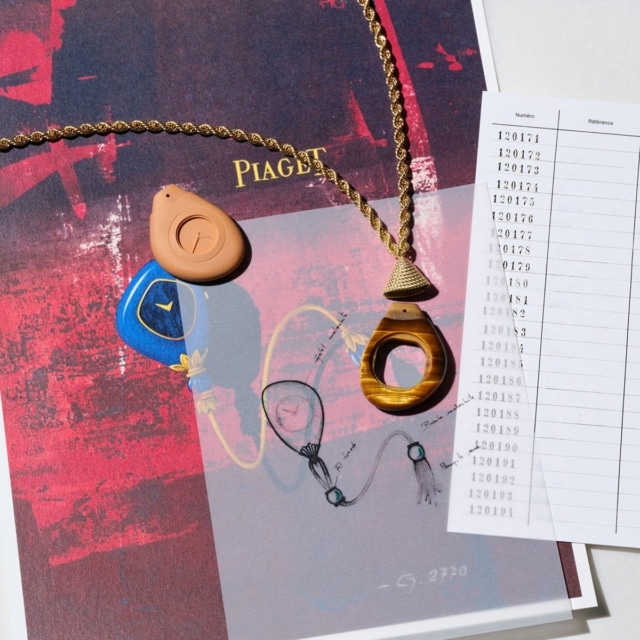
And the 2026 offerings are just as impressive: They are not just timepieces; they are wearable works of kinetic art, as Piaget continues to explore this energy with a new line called Swinging Pebbles.
These objects are sculpted from a single slice of semiprecious stone – tiger’s eye (Ref. G0A51410), verdite (Ref. G0A51408), or pietersite (Ref. G0A51409) – delicately carved out to house a Manufacture movement before being closed to form a smooth, pebble case. Moreover, as a tribute to Piaget’s expertise in goldsmithing and chain-making for everyday life, each pendant hangs from a sinuous, twisted gold chain (rose gold for the verdite, white gold for the pietersite, and yellow gold for the tiger’s eye).

Reinterpreted with a modern sensibility, these new Swinging Sautoirs offer a refined entry into Piaget’s world of artistry and movement. Together, they represent the continuation of Piaget’s legacy of innovation.
Sixties on a Strap
Last year at Watches and Wonders 2025, Piaget also channeled its history of artistic innovation with a brand-new collection called Sixtie for its mid-century spirit and for the simplicity of its function – to mark sixty seconds, sixty times an hour.
At the time, Piaget wrote that the Sixtie was not to be defined as a timepiece, but rather a jewel to grace the wrist. Needless to say, this 29mm x 25.3mm, super-thin watch was a hit, largely thanks to the fluid feel of its trapezoidal case, the stepped gadroons carved into the bezels, and the integrated bracelet.
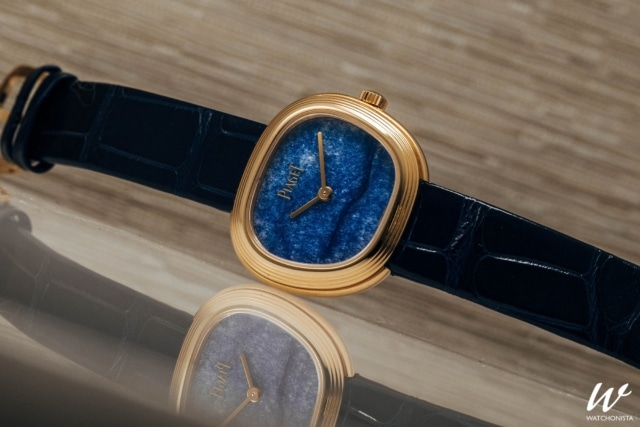
This year, the collection is expanding with two new versions, both set on comfortable alligator straps. These dark blue wrist wraps show off the sculpted case in a whole new light.
There are also two new dial variants – a silvered solar satin-brushed dial with gold Roman numeral markers (Ref. G0A51332) and, in keeping with Piaget’s talents with ornamental stone dials, a marbled blue quartz dial (Ref. G0A51335).
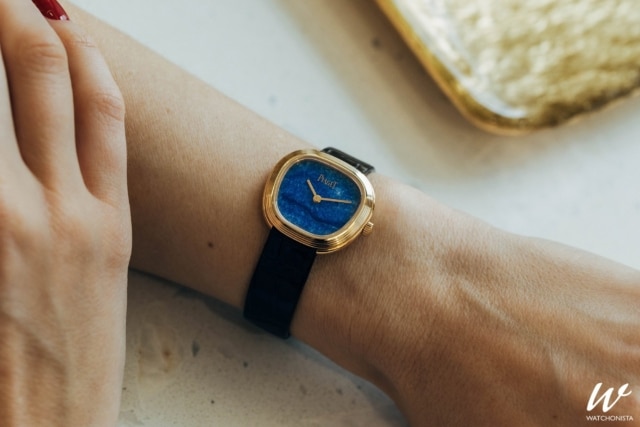
We are partial to the hardstone dial because its blue veins and darker streaks make each piece unique. And what is more timeless than a rock?
Piaget Polo 79
Speaking of motion, the Sixtie isn’t the only member of the Piaget family that loves a good gadroon. More than just a groove, these decorative striations are also a signature of the Polo 79.
Introduced in 1979, the timepiece quickly became one of the defining status symbols of the 1980s. As Piaget’s president, Yves Piaget, likes to say, “The entire philosophy behind the Piaget Polo can be summed up in a single sentence: it is a bracelet featuring a watch, not a watch featuring a bracelet.”
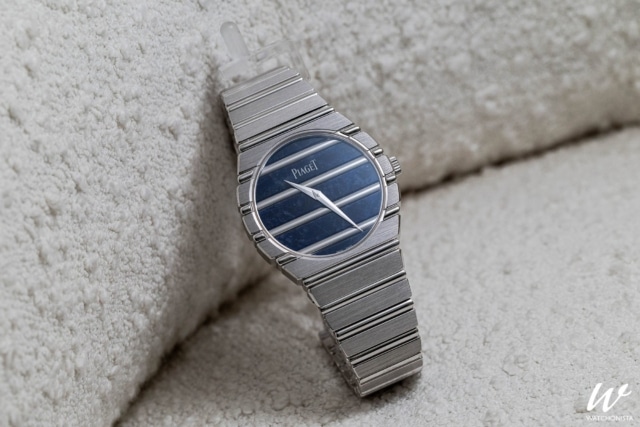
It is also a very versatile piece. The Piaget Polo 79 has taken on many guises over the decades; this year, it returns in a 38mm two-tone white gold version, powered by the ultra-thin self-winding 1200P manufacture movement.
The 2026 Polo 79 (Ref. G0A51151) also explores Piaget’s expertise with ornamental stone. While the Polo has previously employed onyx and lapis lazuli dials, this season, they are introducing a slice of sodalite.
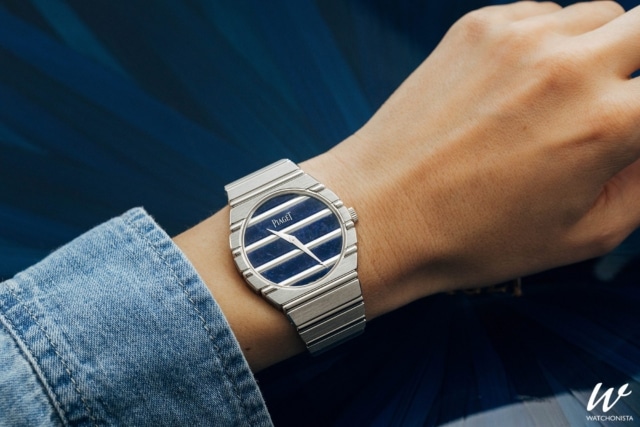
The Maison has extended its signature stripes across a deep blue dial. The interplay of these graphic lines continues all the way around the wrist, thanks to the equally iconic integrated bracelet. Due to these luxe touches, this 2026 iteration never feels like a period piece. Because for Piaget, time is always in motion.
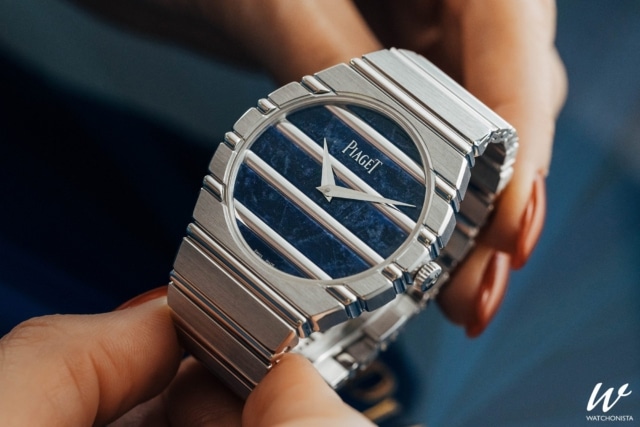
The Polo 79 is priced at CHF 84,500, the Sixtie with blue quartz dial at CHF 18,600, and the silvered solar dial at CHF 14,400. For the Swinging Pebbles collection, kindly refer directly to the website for more information.