Dial Tones: Baume & Mercier Releases Two New, Ice-Blue Clifton Baumatic Limited Editions






Novelties, Watches and Wonders Geneva 2026
The Geneva Comeback Story of the Cartier Roadster
The Maison’s iconic driving watch returns with a familiar look and feel, streamlined and refined for a new era.


The new millennium was an interesting time in the world of watchmaking – cliché as it may sound, the new century really ushered in a new era of horology that has served to diversify and expand the craft exponentially over the past 25 years.
The ‘80s and ‘90s were strange, transitional decades – the industry was just finding its footing after the quartz crisis, and these now neo-vintage models continue to be a source of debate and polarization. By the 2000s, we saw watchmakers gaining renewed confidence and beginning to catch their stride again.
One such example is Cartier, which debuted a new collection called the Roadster just after the turn of the new millennium in 2002. As the name suggests, this driving watch was the perfect foil to the brand’s signature pilot’s watch, the Santos, which had been released a century prior.
However, the story of the Roadster was ultimately short-lived, and the line was discontinued a decade later in 2012 in favor of greater attention to the Maison’s flagship collections. Today, Cartier writes a new chapter in that story with the return of the Roadster, making its comeback at this year’s Watches and Wonders.
The Road to the Roadster
Cartier is among the brands in the industry with a rich history and clear design language from its early days. While its roots are in jewelry making, timepieces quickly came into play and became a focal point of the brand’s catalog with models like the Santos in 1904 and Tank in 1917 rising to icon status not just within the Maison but the industry at large.
These designs place attention on architecture and shape while bucking convention, and these principles have set the tone for Cartier’s subsequent offerings. With the original Roadster, the brand maintained continuity with that same emphasis on unconventional architecture and shape, introducing a new tonneau or barrel-shaped case into its repertoire.
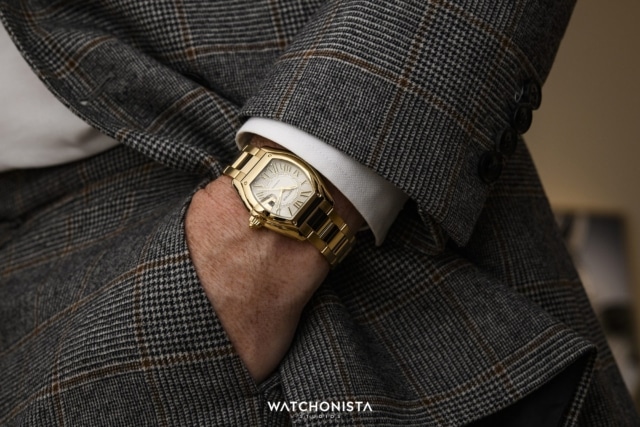
The original Roadster had a few other defining features aside from the notable case shape, borrowing bold codes from the world of mechanical bodywork. It offered a speedometer-inspired dial layout with a cyclops magnifier over the date at 3 o’clock, fashioned to resemble the curved headlight of a racecar. In addition, it featured a large and stylized conical winding crown designed to look like a car radiator or tire – a feature that also made for easy grip and adjustment when setting the time, with or without sporting driving gloves.
The Comeback
Today, Cartier gives the cult classic collection a well-deserved comeback with four new editions, each with the option of a strap or bracelet. The lineup includes classic style combinations that are quintessentially Cartier, with a full yellow gold version and another one in two-tone yellow gold and stainless steel, along with two straightforward stainless steel variations.
The yellow gold and two-tone keep a neutral color palette with yellow-gold accents on the dial from the Roman numeral hour markers to the hands and date window. Each is topped off with an equally neutral grey leather strap as an alternative to the corresponding bracelet.
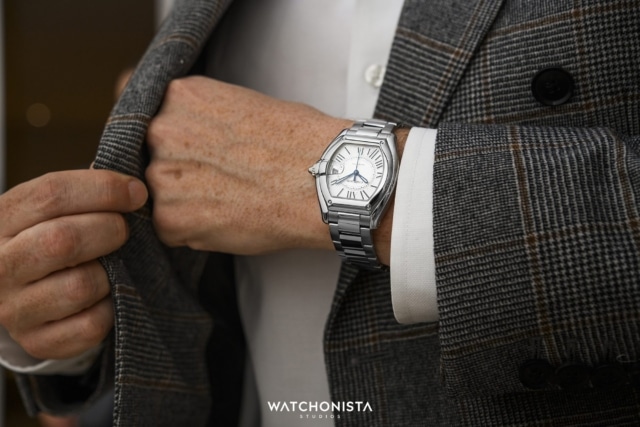
On the other hand, the two stainless steel versions get a touch of blue in different iterations – one showcases iconic blue steeled hands and Roman numeral hour markers with a color-matched blue leather strap option, and the other offers a deep navy dial with contrasting Roman numeral hour markers and hands in stainless steel along with a sportier strap color matched in the same navy with a pattern and texture mimicking that of the bracelet.
Getting down to the particulars of the trademark architecture, the design is a bit more streamlined than the original from 2002, making the watch even more aerodynamic and sophisticated, while maintaining the sculptural integrity of the model that started the collection. Here, you have redefined proportions in two sizes (medium and large) as well as sharpened lines to enhance the model’s distinctive shape.
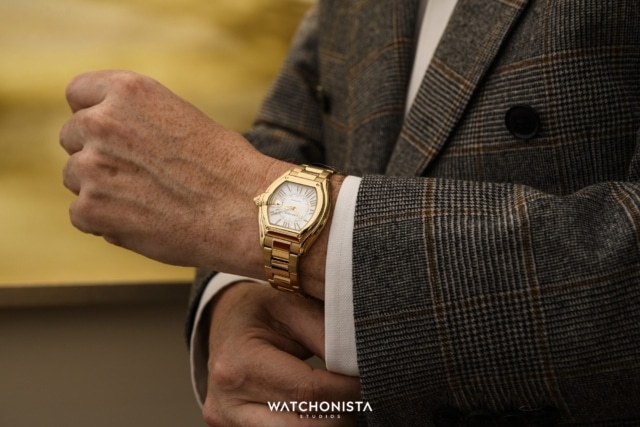
In the new incarnation, you’ll notice a more seamless balance between the bezel and the case, as well as an integrated crown. The interplay of the crystal and the metal amplifies the overall shape and unifies the crown, the magnifier, and the dial, which are accented by the calendar aperture and the metal cabochon.
Moving on to the dial, Cartier has preserved the circular striated pattern, the rail track, and the Roman numerals. However, the difference lies in three meticulous decorative techniques: an appliqué effect created by a stamping tool, adding relief; a varnish applied to the index; and a transferred rail track.
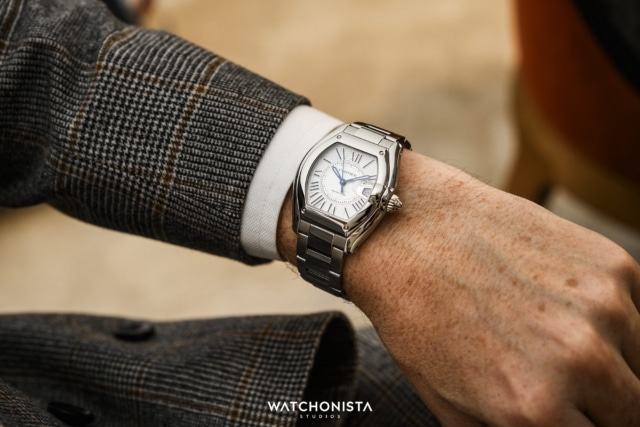
Each model is topped off with the choice of the aforementioned straps or a bracelet. Here, Cartier adds the last touch of refinement with a reworked bracelet design that both refines the aesthetics and optimizes the functionality, thanks to shorter, more ergonomic links and a combination of polished and brushed surfaces along with the Maison’s patented QuickSwitch system.
Pricing & Availability
Each of the four new models is powered by one of two signature self-winding mechanical movements: the 1847 MC for large models and the 1899 MC for medium models. This new group of Roadsters joins, or rather rejoins, Cartier’s catalog today. For more information, including pricing, head over to the Cartier website.