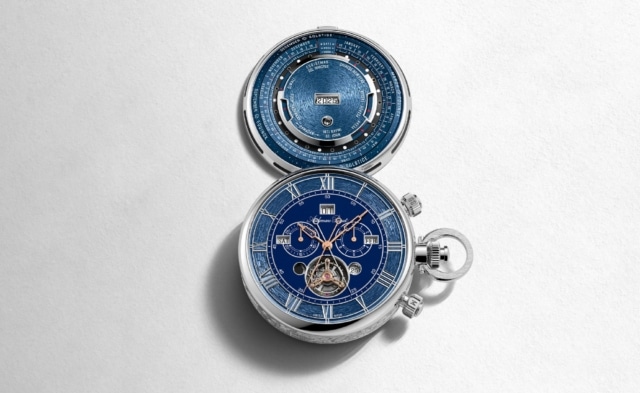
TimeForArt Auction Spotlight: Gerald Charles x Igor Mitoraj Luci di Nara






Novelties
Exposed: Audemars Piguet’s Two New Royal Oak Double Balance Wheel Openworked Models
The layered dials of these time-only models pay tribute to the haute horlogerie manufacturer’s artisanal talents.


In January, Audemars Piguet opened the “Arc” – a sustainable new manufacture in Le Brassus, Switzerland. The 23,700-square-meter facility is meant to bring the brand’s production teams together to solidify its commitment to protecting watchmaking expertise in the region where it has been based since 1875.
Today, AP launched a series of timepieces with openworked dials, including the 39mm titanium with BMG (bulk metallic glass) and the 37mm 18-karat yellow gold Royal Oak Double Balance Wheel Openworked. Like the “Arc,” these Royal Oak Double Balance Wheel Openworked pieces also illustrate how heritage can be cutting-edge.
Open Secrets
The origins of openworked watches can be traced back to the 18th century, when watchmakers like André-Charles Caron and Abraham-Louis Breguet removed the dial (or replaced it with rock crystal) to reveal the mechanism below. With everything on display, of course, the watchmakers started to decorate the bridges and plates.
Openworking has been an Audemars Piguet specialty since the 1930s. During the Great Depression, when the economy was slow, AP watchmakers revived this historical art form to occupy their time and keep their skills honed. It’s a practice that has continued to this day with the Royal Oak Double Balance Wheel Openworked.

Beyond openworking, the various components of these new Royal Oak Double Balance Wheel models display rarified haute horlogerie decorations, including satin brushing, circular graining, snailing, and chamfering. Balancing function and aesthetic refinement, these finishes create striking contrasts and plays of light.
Golden Anniversary
Just as the “Arc” has united Audemars Piguet’s technical and creative teams, the 37mm Royal Oak Double Balance Wheel Openworked brings many of these decorative traditions together in one watch.

The case is entirely crafted from 18K yellow gold. This warmth extends to the dial and, therefore, to the gold-toned openworked, self-winding Calibre 3132. This patented movement features a double balance wheel mechanism, introduced by the manufacture in 2016, which has become a standard for precision and stability.
The watch doesn’t live in the past. Tone-on-tone timepieces are au courant, and silver-grey luminescent hour markers and hands look modern while providing peak readability. Other contrasting touches include a rhodium-toned openworked dial and blackened 18-karat white gold rectangle hour markers.

Meanwhile, the 39mm titanium with BMG (bulk metallic glass)-encased model features an integrated titanium bracelet with BMG studs and a three-blade folding clasp. Fun Fact: BMG-titanium is a hybrid material that offers the “best of both worlds,” combining the strength of titanium with the high strength, toughness, and flexibility of an amorphous metal.

On the back of the watch, the sapphire case back reveals a golden oscillating weight, thus completing the watch’s monochromatic harmony.

Final Thoughts
The Royal Oak Double Balance Wheel Openworked also speaks to the cyclical nature of watchmaking. When key wound pocket watches went out of favor, the timepieces were disassembled, and their carefully embellished verge escarpments were turned into pendants and brooches.
The Royal Oak is, of course, the ultimate sports watch. But since its introduction in 1972 – another era of economic upheaval in the watch industry – it has also become a status symbol.

With its luxurious materials and gorgeous decoration, these new Royal Oak Double Balance Wheel Openworked provide an unapologetic balance between precision and adornment.
Pricing & Availability
Available now, the new 37mm Royal Oak Double Balance Wheel Openworked in 18K yellow gold is priced at CHF 81,300, while the 39mm titanium version’s price will be given upon request.
For more information, check out the Audemars Piguet website.