MB&F LM1 EVO: Updates Tempt Me to Put My Money Where My Mouth Is






Novelties, Watches and Wonders Geneva 2026
Bold Gold: Cartier’s Watches and Wonders 2026 Releases In 18K Are Far From Mellow Yellow
Cartier enters its Golden Age with several new releases in the warm, sun-kissed metal.

Although gold, as a case material, can be traced back to the Nuremberg Egg era of timekeeping (think mid-1500s/pre-pocket watch days), and was used in thread form as well as in the case to create what is hailed as the first ever wristwatch (crafted by Abraham-Louis Breguet in 1810 for the Queen of Naples), it has seen its ups and downs in terms of popularity in the centuries since.
In terms of wearable trends, yellow gold still reigns supreme, particularly in the 20th century. The Art Deco era (think the Roaring Twenties into the 1930s) saw gold jewelry paired with colored gems and diamonds. The retro era, which encompassed the two decades that followed, allowed for chunkier gold designs and semi-precious stones to be used.
The 1980s were probably when yellow gold was loved the most, as it appeared in the form of large hoop earrings, multiple rings, layered chains, and watches. However, while the 1990s and 2000s saw a shift to silver, platinum, and white gold, 2010 brought the warmth of yellow back to fashion and accessories. The jewelry and watch industries haven’t looked back since.
Case in point: At this year’s Watches and Wonders in Geneva, Cartier released a slew of yellow-gold timepieces, from new Santos-Dumont and Baignoire models to the introduction of its new Myst collection.
Right Time, Right Case
Thanks to Cartier’s archives and historians, we know that the first yellow-gold Cartier Santos-Dumont was introduced in 1911 (the watch was originally released in 1904 in platinum and white gold). Fast forward 115 years to the 2026 edition of Watches and Wonders in Geneva, and Cartier released three new Santos-Dumont models, two of which are in yellow gold (with the third in platinum).
While the Santos-Dumont collection has been a relative staple at previous Watches and Wonders editions, this year’s versions put an emphasis on precious metals, silky-feeling bracelets, and a slightly smaller case size (43.5mm x 31.4mm).
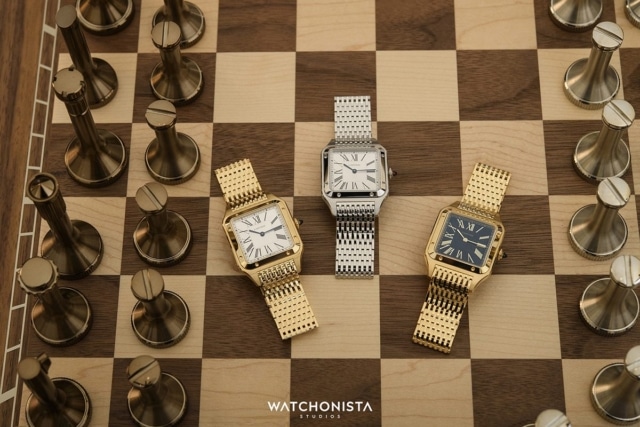
Staying mostly true to the 1904 version of the Santos-Dumont, this year’s platinum edition, the Santos-Dumont LM Platinum, is adorned with the traditional Cartier Roman numerals set against a silver-toned, softened satin sunray-effect dial that is accentuated by the edition’s recognizable exposed screws on a brightly polished bezel. These textures are complemented by a satin-finished case and a circular-grained crown that, as with all platinum Cartier watches, is accented with a ruby cabochon.

The watch also includes an interchangeable mesh bracelet comprising rows of 15 elegant links, each measuring 1.15mm. Lastly, this timepiece is equipped with the 430 MC hand-wound mechanical manufacture movement.
Now that we have discussed the platinum Santos-Dumont, let’s discuss what Cartier had in store with regard to releases in yellow gold.
“He Who Has the Gold, Makes the Rules”
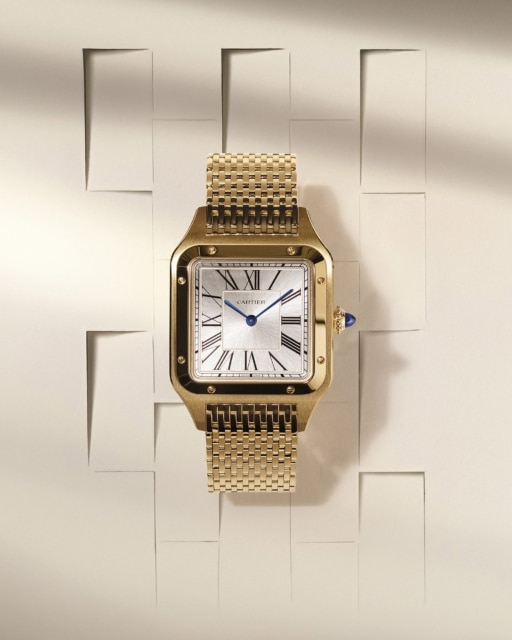
As previously mentioned, Cartier also released two new yellow-gold versions of the Santos-Dumont, and they are nearly identical to the platinum version. The first, the Santos-Dumont LM YG, features the same silver-toned, satin-finished sunray-effect dial and blue hands as the platinum model, but, as with all gold and steel versions of Cartier watches, the beaded crown is adorned with a blue sapphire cabochon.
For the second yellow-gold model, Cartier went for something a bit more obscure, equipping this version with an obsidian dial embellished with gold-tone Roman numerals at the hour markers and gold sword-shaped hour and minute hands.
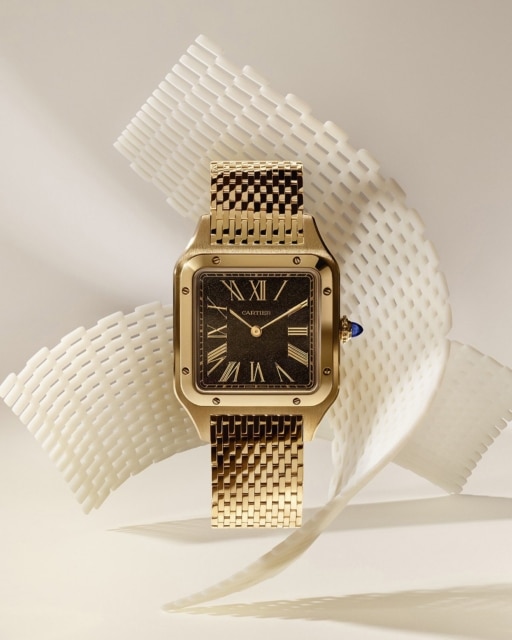
For those unfamiliar with the mineral-like material, obsidian is technically an igneous rock produced from felsic lava (a volcanic glass formed when lava cools quickly, forming a crystal-like substance). The material, which is a mixture of metallic black and grey, is unique in that no two pieces of obsidian are alike.
Moreover, the contrast of the gold hands and numerals against the darker colored dial, along with the polishing differences on the gold bezel, case, and multi-link bracelet, creates an exceptional-looking timepiece that would easily seem at home on any gender’s wrist.
But That’s Not All
The Cartier appointment, as it is every year, is one of the most popular appointments at Watches and Wonders. It is quick-moving and organized, and sometimes, as a member of the media, I wish I had more time to soak everything in. You’ve likely already read about many of the incredible releases the brand put forth this year, but since we are focusing on Cartier’s history with gold in this article, I would also like to give a shout-out to a couple of other collections.
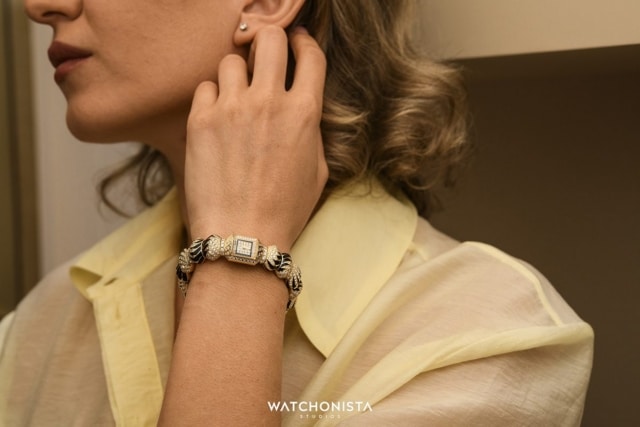
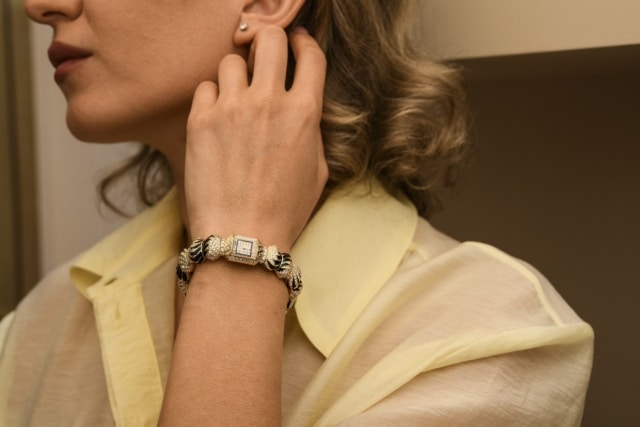
One of my absolute FAVORITE collections saw two new pieces introduced in Geneva. The Myst de Cartier – which is more of a high jewelry watch equipped with a flexible non-clasp bracelet and contains a quartz movement – was introduced in an all-diamond white gold version, as well as a yellow gold, white diamond, and black lacquer version, which almost has the feel of a Panthère with regard to coloring and design.
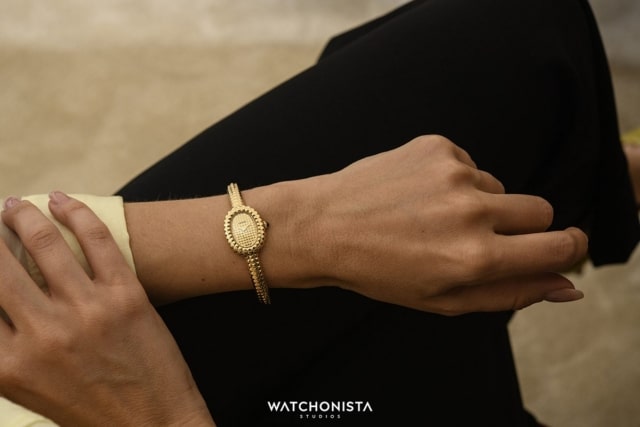
Lastly, the maison also introduced new versions of the Baignoire watch (originally named in my birth year, 1973, thank you very much), which has gained new popularity among Gen-Z and Gen Alpha celebs and influencers. The novelties were introduced in all-yellow-gold versions replete with clou de Paris studs, smooth yellow-gold cases with leather straps, and diamond-and-yellow-gold versions.
For more information, including pricing and availability, check out the Cartier website.