All Hail: Brew Celebrates New York City at the Windup Watch Fair with a Tribute to the Iconic Checkered Taxi



In-depth, Watches and Wonders Geneva 2026
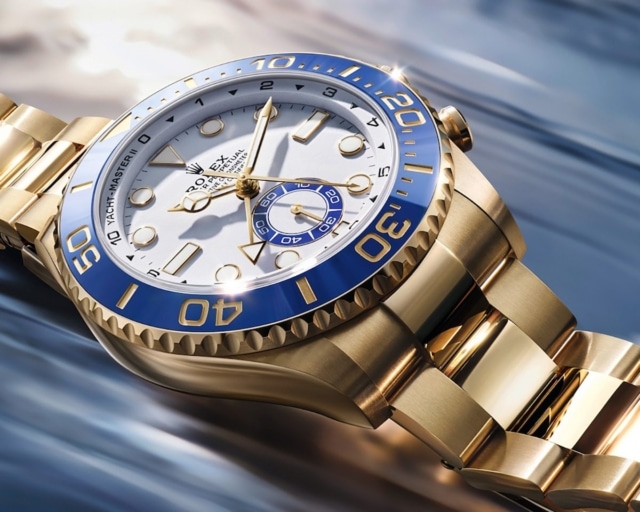
Sailing in Clear Air: An In-Depth Look at Rolex’s New Yacht-Master II
While the innovations inside Rolex’s latest evolution of its classic yachting timepiece may seem subtle, they pay off not only by presenting an ever-better “tool” watch for sailing, but also by delivering an even better-looking wristwatch, overall.

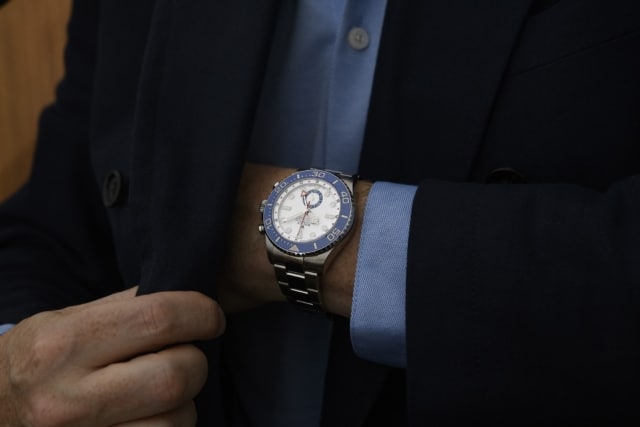
As you probably already know, Rolex doesn’t really do movement or design modification unless there is a really good reason for it. Frankly, that reason is usually improvement. However, not mere visual improvement, but improvement to the core intent of the watch itself.
Functional advancements lead to more authenticity, and authenticity leads to increased appeal – even if your time aboard a boat is generally spent sunning yourself on deck, not so much working the wheel and the lines.
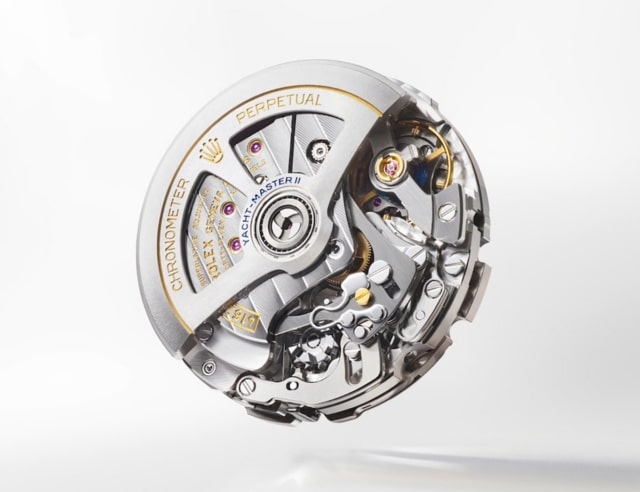
Powered by a new, purpose-built self-winding calibre 4162 movement, the technology inside the new Yacht-Master II allows for some revisions to how timing plays into sailed racing that, while in a sense seem simple, are dramatically different (and better) than ever before.
Moreover, while there are some thoughtful, innovative engineering switch-ups for sailors, to be sure, the final result also presents a more legible, cleaner design for the timepiece for everyone’s eyes to enjoy, with most of the visual and mechanical innovation, tellingly, centered around the presentation of the critical regatta timer function.
But first, some background.
Regatta Timing (Can Mean Everything)
For the less familiar, the “starting line” for a yacht race is generally between two floating buoys. Vessels tend to mill about in the area fairly far back on one side of the line, anticipating a period of jockeying for position before the start of the race (which is kicked off from an officiating boat with loud airhorn blasts and flags).
The first horn/signal allows sailors to begin maneuvering their craft towards the starting line, with the goal of being as close to that “line” as possible when the second horn/signal goes off to officially start the race. If you cross the line before the horn blows, you are penalized and have to spend valuable time tacking your way back around the buoys to cross the line properly.
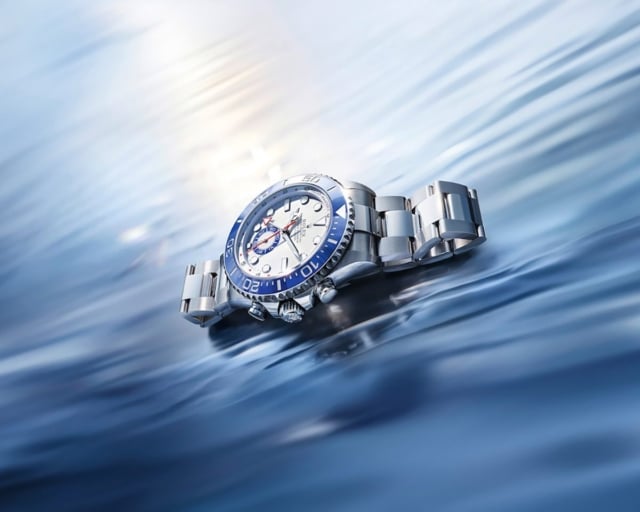
This is what regatta watches all have a complication designed to act as a 5-to-10-minute countdown clock; a good start is critical, often spelling the difference between victory and defeat.
So, “jockeying” phases between the two horns can vary from race to race, but 3, 5, and 10-minute intervals are common, with the final 30 seconds before the start being particularly important. Skippers really need to know how much time they have left before the kick-off, and to use it wisely. In that sense, a regatta timer is not so much a stopwatch as it is a “go…now!” watch.
Fortunately, the capabilities of the new Yacht-Master II movement not only address the need for timing flexibility but also the “jockeying” phase’s more urgent need for clear readability in this make-or-break timing event.
The Forward Tack
The previous generation of the Yacht-Master II, powered by the calibre 4161 (which was introduced in 2013), did indeed provide a “programmable” regatta timer that allowed for up to 10-minute pre-start intervals using a Ring Command Bezel system, the watch’s crown, and a familiar chrono-pusher that sparked the central, clockwise-running seconds hands to begin the countdown.
However, that regatta timer’s gauge, with its large red arrow, ran just inside that watch’s index chapter; effective but perhaps a little overly technical in terms of dial design, and the entire process was overly complex (to put it mildly) with its combination bezel/crown/pusher operation.
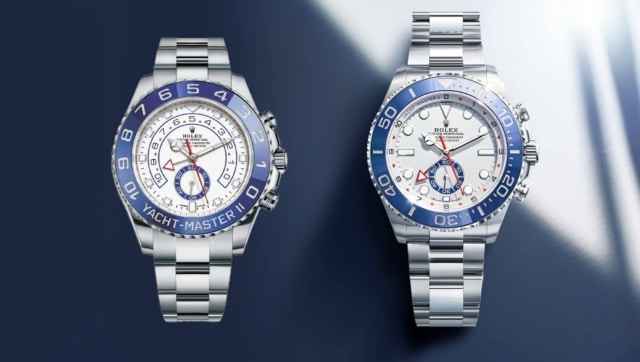
Simplicity meets legibly in the new Yacht-Master II’s regatta timing function. The operation is reduced to just a relatively thin outer gauge (which acts as a sort of flange) and pushers. Meanwhile, the timepiece’s blue ceramic bezel functions as a normal bi-directional bezel. A permanent small seconds sub-dial remains from the earlier Yacht-Master II design.
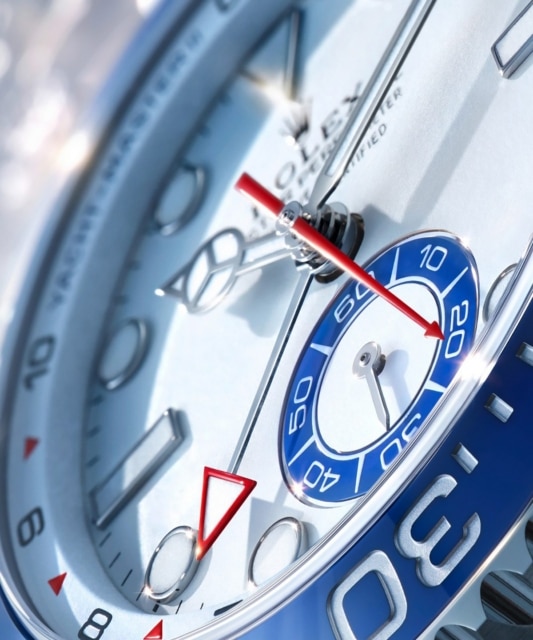
The pusher at 4 o’clock programs the minute interval with a broad-arrowed GMT-style hand along the zero to 10 outer ring, and the upper pusher sparks the bright-red central seconds hand, which now runs counterclockwise. In this author’s opinion, this is a particularly inspired visual switch-up for a countdown function (remember, not a stopwatch, but a “go…now!” watch).
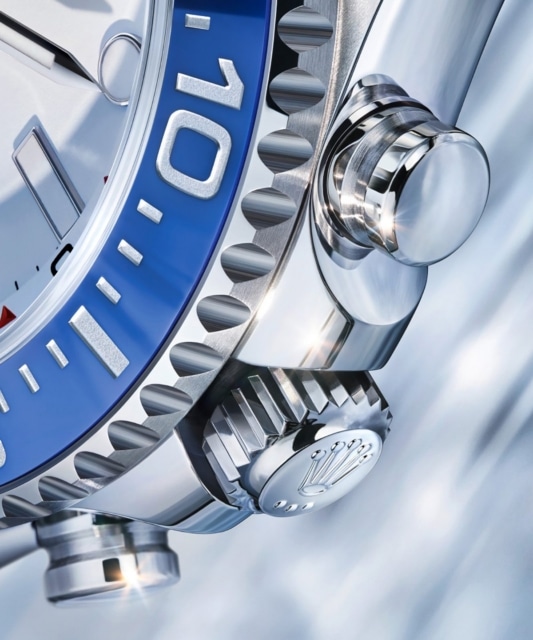
This reverse-action, broader seconds-counting approach across the gleaming white dial is particularly effective in the final 30 seconds before the start horn blows. The top pusher stops the central seconds hand (or you can let it keep running, if you so desire), and the bottom pusher then acts as a resetter for the whole sailing shebang.
Some Extra Wind for the Sails
The new calibre 4162 movement not only presents this re-engineered timing function, but it also brings more recent Rolex innovations to the timepiece, such as the high-efficiency Chronergy escapement and new barrel architecture that deliver a robust power reserve of 72 hours. Thus, you are getting an even better racing tool and an even better Rolex, in general.
While the Yacht-Master II’s impressive case size and bracelet remain relatively unchanged from the prior executions (44mm and three-link Oyster, respectively), the simplified dial design helps it wear smaller in a sense; more a practical, clean wrist companion and less of a burly wrist edifice.
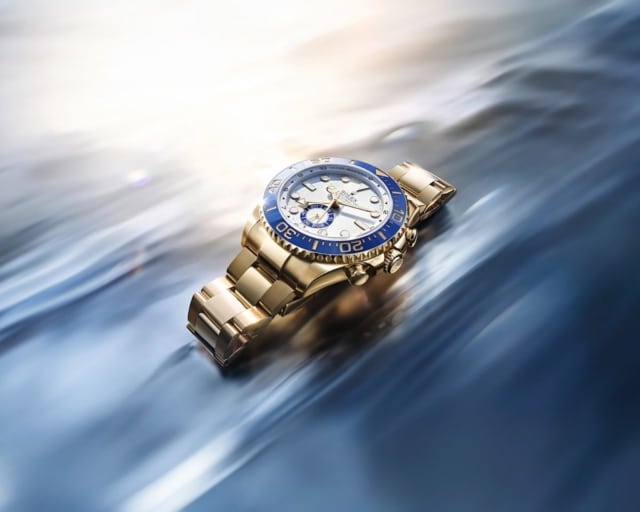
Available in proprietary Oystersteel (Ref. 126680) for $20,300, or in 18K yellow gold (Ref. 126688) for a decidedly “captain of the ship” vibe for $57,800, you can learn more about the new Yacht-Master II via the Rolex website.