Omega Speedmaster Effect: Three Collectors, Three Distinct Personalities




In-depth
The Midas Touch: Five Crucial Jewel Designer x Watch Brand Collaborations
A look at the horological contributions of Gilbert Albert, Carolina Bucci, Andrew Grima, Serge Manzon, and Jean Schlumberger.

The worlds of jewelry and watchmaking intersect all the time. Haute horology houses such as Audemars Piguet, Patek Philippe, and Vacheron Constantin all offer high-jewelry models, and luxury jewelry maisons like Belperron, Van Cleef & Arpels, and Piaget all create watch collections.
For the most part, these fantastic timepieces are created in-house, their designers operating in anonymity. But there have been occasions where brands have reached out to celebrated jewelry designers to apply their jeweler’s point of view to a watch or two, giving these artistes free rein to show off their signatures. Here are five of our favorite collaborations.
Andrew Grima for Omega
Watchmaking in the 1960s was a mod, mod world. And when it came to jewelry, Andrew Grima (1921 to 2007) was the swingingest cat on the scene. He had an exclusive boutique on posh Jermyn Street; the clientele for his modern designs included both Queen Elizabeth II and Princess Margaret. And his work is on display at the Victoria and Albert Museum.
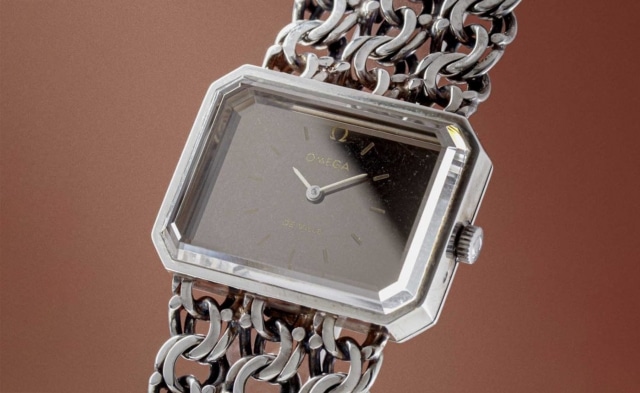
And while Grima had never designed a watch (once famously saying, “If you need to know the time, ask your chauffeur”), in 1969 Omega’s Director of Production, Robert Forster, commissioned Grima to design a collection of watches for the brand.
Called the About Time collection, these unisex wearable works of art were set in ornate, precious-metal bracelets or bangles, with the watch face hidden behind cut gems. Grima’s goal was to create pieces of incredible jewelry that “happened” to tell the time.
Some Fun Facts: First, although the somewhat brutalist designs were undeniably Grima and advertisements from the time touted the connection, the watches themselves were unsigned by either Grima or Omega. Secondly, each piece was handmade in London and then shipped to Bienne to be fitted with movements by Omega technicians.
And while Grima went on to produce 55 watches for the About Time collection, they rarely come up on the secondary market. More accessible forwould-be collectors is a series called the Time in Style, which capitalized on Grima’s chunky designs. These watches were more affordable and marketed through the De Ville, Constellation, and Jeux d’Or ranges.
Unlike the original Grima series, the Time in Style watches did, in fact, have Omega on the dials, more conventional dial layouts including hour markers, and were entirely made in the Omega factory. The Grima effect also impacted watch design across the board; you can find examples of angular watches with thick, faceted crystals from brands ranging from Glashütte Original to Timex online.
Serge Manzon for Longines
While the Grima-designed Omegas encapsulated the groovy spirit of the 1960s, in 1973, Longines went for something funkier with their Serge Manzon collaboration.
The self-taught Manzon (1930–1998) worked across several disciplines. Including furniture, lighting, and jewelry. With each of these endeavors, he brought a sculptural sensibility. His foray into watch design was no different.
What emerged was a collection for Longines that feels less like watchmaking and more like wearable sculpture pulled from a different timeline. Presented at Basel in 1973, the collection represented a clear break from Longines’ more traditional design language. Heck, they barely looked like watches at all, feeling closer to industrial design or contemporary art than traditional horology.
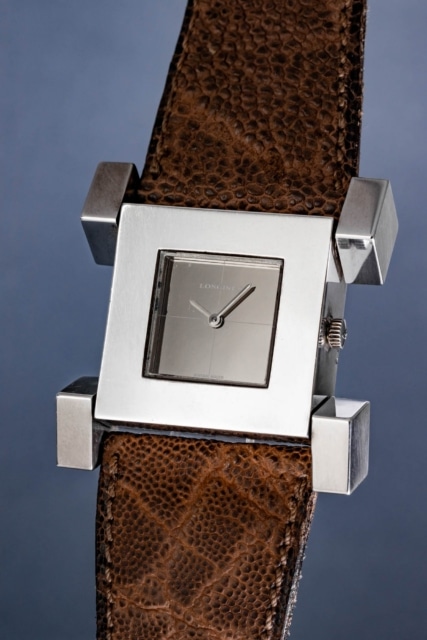
There were 11 unisex watches in the collection. All were cased in sterling silver and strapped to the wrist with thick leather straps. Sometimes the cases were stretched, other times compressed. Sometimes they were flat; sometimes they were curved. Bracelets became architecture. Some styles were mechanical, others were quartz-powered. And while the partnership lasted only a year, the Manzon-designed pieces are relatively plentiful on the secondary market.
Jean Schlumberger for Tiffany
Jean Schlumberger was born into a well-to-do family in France, and although the boy showed a proficiency for the arts, his family, which was involved in the textile business, would not permit him to undertake formal training. Eventually, he found his way into the jewelry business by creating buttons for Elsa Schiaparelli in the 1930s. Schiaparelli later commissioned him to design costume jewelry for her firm.
In 1946, Schlumberger opened his own jewelry salon. In 1956, the president of Tiffany & Co., Walter Hoving, asked Schlumberger to work for him. He stayed with Tiffany until he retired. Despite his loyalty, Schlumberger was one of just four jewelers and industrial designers who were allowed to sign his work for the brand.
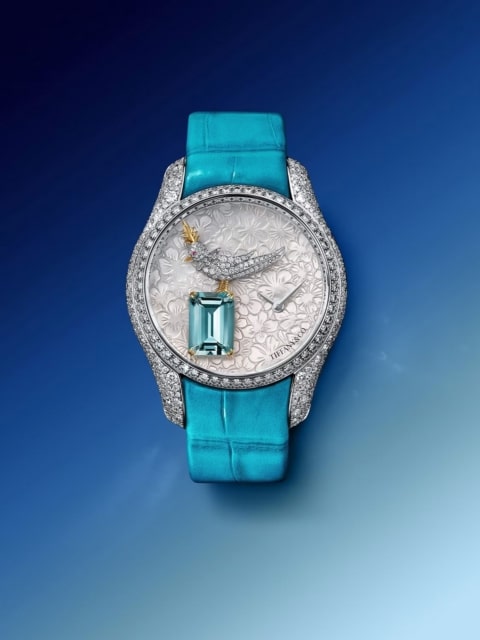
While Schlumberger is best remembered for whimsical interpretations of natural forms, including the iconic Bird on a Rock, he also crafted a captivating collection of watches for Tiffany. Perhaps the best-known example of the Schlumberger is the rectangular 23mm 18K yellow gold watch made famous by the late Vogue editor André Leon Talley.
This 1990s-era watch featured a lovely mélange of classical and contemporary attributes, including a wider-than-average bezel, a backset crown on the back, and a brown leather strap with a detachable yellow-gold clasp that met at the lugs.
Powered by a quartz movement, the unique case with its wide bezel features a crown on the back, and a brown leather strap with a yellow-gold frame snaps over the top of the case to hold it in place. The elegant yet industrial vibes of this watch were a bold departure for both Tiffany and Schlumberger
Carolina Bucci for Audemars Piguet
Sometimes a simple glow-up can completely transform a timepiece. That’s what happened when Italian jeweler Carolina Bucci reimagined Audemars Piguet Royal Oak in 2016.
Initially, Bucci gave the RO a new look by applying her signature Florentine (hammered gold) finish. This gave the case and bracelet a “Frosted Gold” look that glittered without diamonds. The fourth-generation Italian jewelry designer then contrasted the textured surfaces with a mirror-polished dial.
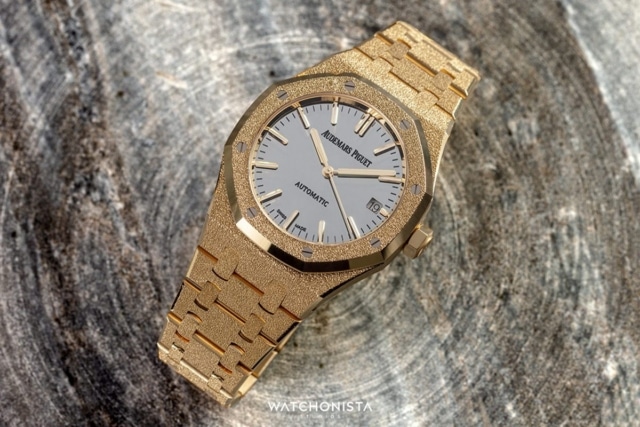
Bucci has gone on to collaborate with AP several times and on each occasion has produced something unexpected. The jewel of the collaboration is 2022’s black ceramic Royal Oak Selfwinding Carolina Bucci Limited Edition, which doesn’t feature a speck of sparkle but rather a futuristic, holographic dial that, with the twist of the wrist, reveals the RO’s signature tapisserie pattern.
In a quote provided by Audemars Piguet at the time of launch, Bucci wrote, “I wanted to place a rainbow in the most unexpected of places, a little like when you see oil floating on a puddle in a city street … So here you have every color of the spectrum on a canvas that is completely black, which is itself the absence of color.”
Gilbert Albert for Omega
Gilbert Albert (1930–2019) was a Swiss jewelry prodigy. He was hired by Patek Philippe when he was only 25. He worked there as part of the design team and was head of the workshop from 1955 to 1962, during which he worked on what would become a series of highly collectible timepieces. But his real dream was designing jewelry, so he left Patek to open his own atelier in 1962.
Soon, he became famous for his art jewelry that incorporated rough-cut stones and other unconventional materials, such as fossilized dinosaur bones, sea urchin skeletons, meteorites, and hardened lava.
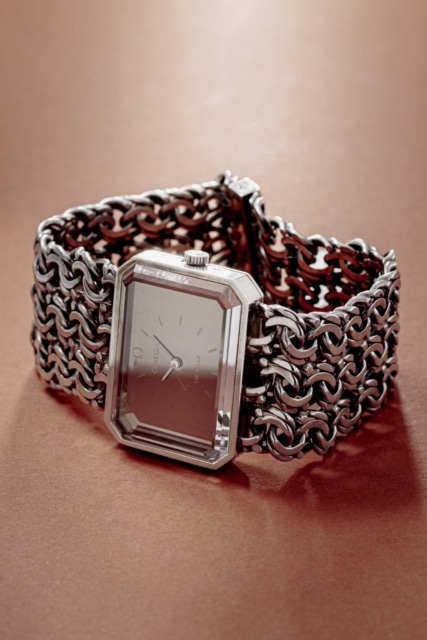
In the late 1960s, however, the watch life drew Albert back in. Designs were all about capturing nature, and in 1968, he produced some of his most daring work for Omega by creating a series of eccentric wristwatches, the most memorable of which was called the Frisson d’Or.
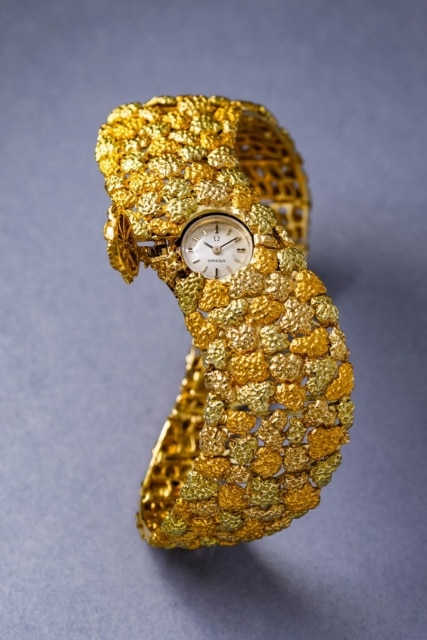
The Frisson d’Or, or the “Shiver of Gold,” was a secret watch that evoked the way coral, living under the sea, moves in the waves. Made in 14k yellow gold, the bracelet ripples around the wrist while a gilt dial lies hidden within, a secret revealed only in motion, like sunlight flickering between shifting coral.
Albert’s most boundary-breaking timepiece was a prototype called the Cobra. While it never went into production, its influence can still be seen in Urwerk’s UR-CC1 “King Cobra” from 2009.