TimeForArt Auction Spotlight: Gerald Charles x Igor Mitoraj Luci di Nara


In-depth
Good To Go: Are You and Your Watches Ready to Roll in Case of an Emergency?
If you stay prepared for a fire or other natural disaster, you don’t need to scramble during an emergency.

I don’t consider myself a prepper, but I do like to be prepared. After reading about horrific wildfires and other natural disasters around the world (like the 2023 wildfires that affected all 13 provinces and territories in my home country of Canada), I even assembled a go bag with important documents and clothing in case I needed to evacuate at a moment’s notice.
But what about our watches? Obviously, getting out safely is a hundred times more important than barging into a burning building to save your Patek. But if you make a solid plan, there shouldn’t be a reason you can’t also protect your precious from catastrophe. That said, what should be in your horological go bag?
Recently, my mother was forced to flee her apartment after a fire in the parking garage. Fortunately, she’s fine. And now, because we’re in the midst of navigating insurance claims and cleanup, I’m learning new information about what to do with your watches in case of an emergency. And I want to share it with you.
Assembling a Go Bag
There are precious few places in the world that haven’t experienced at least one natural disaster in recent years. Most governments in particularly risky areas (such as avalanche zones, cities near fault lines, or wildfire-prone regions) recommend assembling a go-kit before a disaster occurs. This kit should be easily accessible so you can take it with you when you must evacuate. It should also always be packed in case you need to be away from your home for an extended period.
In addition to clothes, flashlights, water, and medicine, your go bag should include important documents, such as insurance policies. With that in mind, your first step in assembling your watch go bag is to document and assess your timepieces.
Like many people, my mother doesn’t have a museum-quality watch collection. Most of it is vintage, and its value is sentimental, including a replacement of the watch that her parents gave her when she was 12.
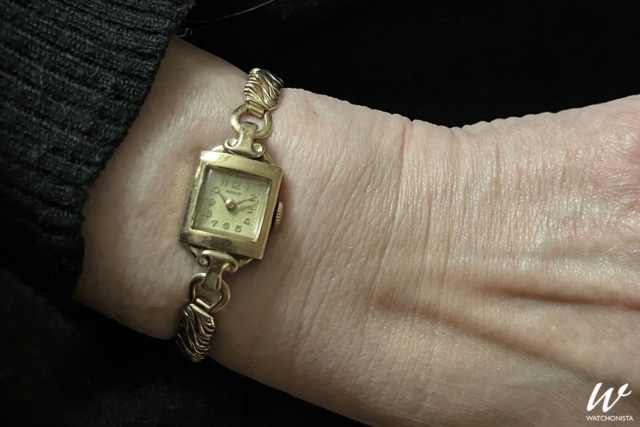
I, on the other hand, have a mixed bag of old and new, collected over decades. And, if I’m being honest, I’m not even sure how much it’s worth. So, first, ask yourself: What kind of collector are you?
“We set up a special watch insurance opportunity for our clients because the demand was so high. Of course, that was magnified after the tragic Palisades Fire,” Eric Wind of Wind Vintage told Watchonista. “We are excited to announce that we have access to a special watch insurance opportunity for collectors with watch and/or jewelry collections over $500,000. It is an excellent insurance provider we personally use, and we have already had a number of collectors sign up for coverage.”
Insurance is assurance. “It’s important that collectors schedule their watch collection at appropriate values and record the serial numbers/reference numbers,” Wind continued. “There is a lot more awareness about having proper insurance coverage now compared to a decade ago, when many collectors had their watches uninsured.”
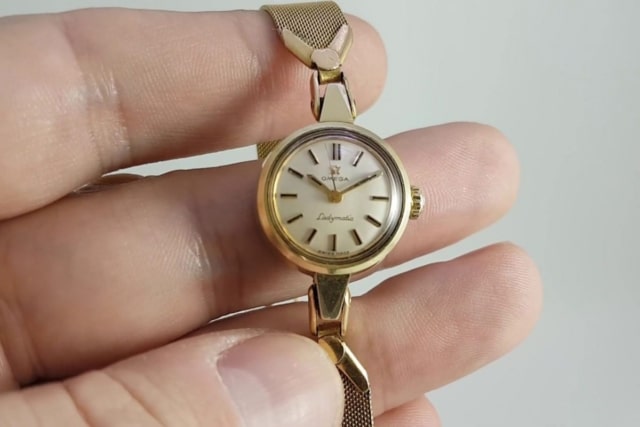
For collectors, archiving in advance can also be fun! It gives you the opportunity to spend time with your timepieces and revisit the story of your collecting journey.
We asked Cat Nelson, Head of Insurance at European Watch Company, who has partnered with Chubb, about how to get started.
“When a loss occurs, insurers often request an appraisal or invoice as proof of ownership,” Nelson explained. “While it’s best to share these with your insurer in advance, you can also build a secure online archive.”
Nelson continued: “Cloud services like Google Drive, OneDrive, or Dropbox allow password-protected access, while platforms such as DigiLocker, Everplans, and Trustworthy offer added security. Clients should scan and upload watch documents – appraisals, invoices, and certificates – to these platforms.”
And if you store this information in the cloud, it won’t take up room in your physical go bag.
Safe Spaces
Watch safes are the opposite of a go bag because they are meant to stay behind during an evacuation. But they still merit some discussion.
If you keep your horological treasures in a safe, you still need to maintain full insurance coverage for its contents. Even if your safe is considered fireproof, watches kept in a home safe can still be exposed to smoke or water damage. And, according to UL Solutions’ standards, which most safe manufacturers follow in designating their fireproof rating, safes are rated for the length of time they can maintain their internal temperature at or below 350° Fahrenheit (177°C).
Why 350°F? Because the char point of paper is close to 400°F (204°C). But extreme temperatures, such as above 140°F (60°C) or below 32°F (0°C), or sudden temperature changes can still affect your watch in other ways. Fun Fact: 18-karat yellow gold typically melts between 1652°F and 1765°F (900°C – 963°C).
For example, shellac used to hold your watch’s pallet jewels in place softens at 140°F (60°C) and melts at 160° to 185°F (70° to 85°C). The lubricants and gaskets in your watches all deteriorate above 200°F. And if you’ve ever examined a tropical dial, you’ll know that certain watch face materials will affect color and luminescence.
On the plus side, if you have too many watches to fit into a go bag, a fireproof safe might prevent a total meltdown, but the only way to eliminate your risk is to put your watches in a bank safety deposit box.
Another note from Nelson: “For physical boxes and papers, focus first on protecting the watch itself. The papers are more important than the box and are usually small enough to be stored in the safe with the watches. Not everyone can store bulky packaging in a fireproof safe, but collectors whose watches derive significant value from original boxes and their accessories should consider a fire-rated safe or temperature-controlled storage for the additional accessories and boxes.”
In The Bag
Another question that came up when I was quizzing industry insiders about assembling a horological evacuation kit is this: Does your go bag need its own go watch?
There are lots of reasons you should have a rough-and-tumble watch on hand. Again, to use my mother as an example, I had given her a Flik Flak dive watch as a loaner when I was supposed to take her everyday watch in for servicing. It has never been to space like a Speedmaster, but the kid-friendly, easy-to-read dial made it useful for telling time as first responders took her and her neighbors to buses and then to shelters during a freezing-cold February night.
Experts wouldn’t recommend a kid’s watch for an evacuation, but speaking with them gave me some insights into what works best under pressure.
Because Victorinox works with hot steel in its manufacturing process, the company formed its own firefighter crew 40 years ago. Daniel Betschart, an officer from Victorinox’s fire department, describes the literal trial by fire of the brand’s I.N.O.X. Carbon models: “Time is the enemy of a firefighter. Everything that can help to bring it under control becomes a firefighter’s friend.”
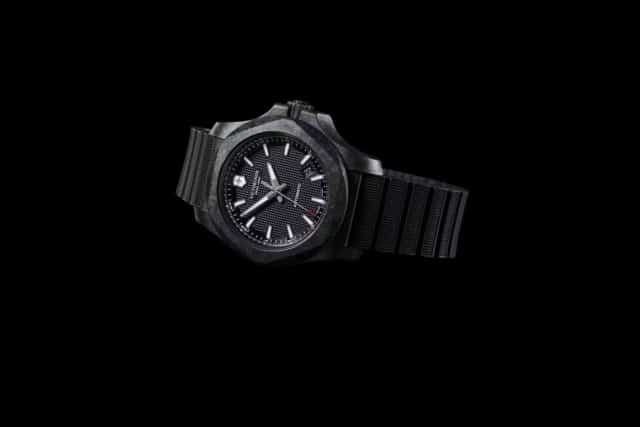
These watches – which feature 43mm cases made from a carbon composite that has protected space shuttles from re-entry temperatures of more than 1,260°C – had to withstand 130 ruthless tests, including falling from a three-story building, withstanding the weight of a fire truck, surviving boiling water and a washing machine, and being frozen in ice. Plus, they feature super easy-to-read hands and indices flooded with Super-Luminova.
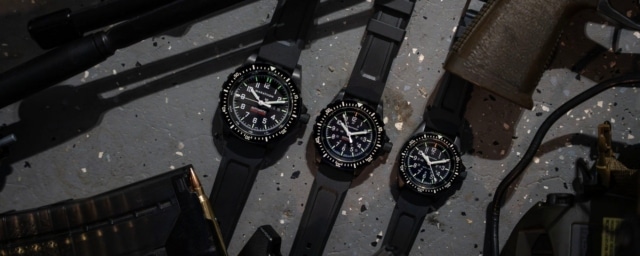
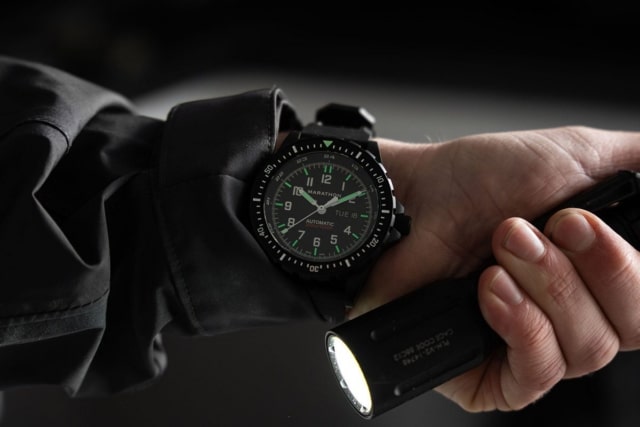
Additionally, building on the foundations of its Search and Rescue dive watch collection, indie brand Marathon recently released three new, rugged watches – the 41mm Anthracite GSAR (Government Search and Rescue), the 36mm Anthracite MSAR (Medium Search and Rescue), and the 46mm Anthracite JDD (Jumbo Day/Date) – which was developed to meet Canadian Government specifications in the early 1990s.
Still in service with US and Canadian forces, these watches employ tritium gas-filled tubes (which do not require an outside light source to recharge their glow) to enable easy time reading in low-light conditions.
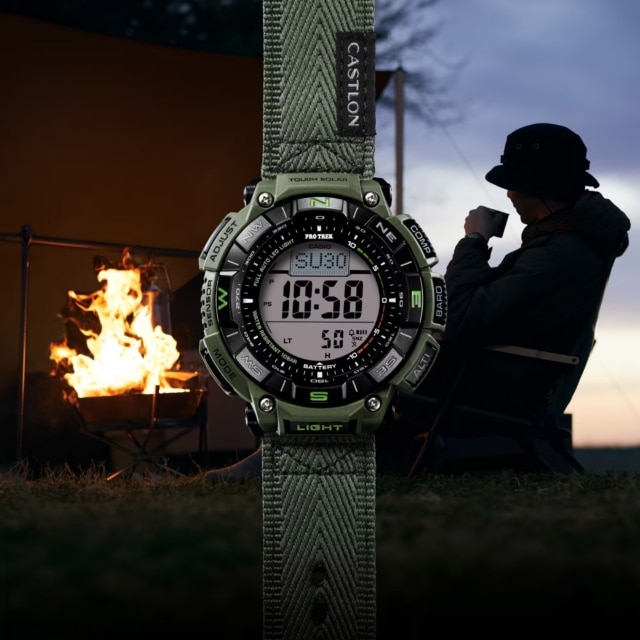
Last but not least, the recently launched Casio PRO TREK PRG-340B-3 merges wearable technology (it provides barometric pressure and altitude readings, temperature, compass, and more) with a kind of modern style (if you can only pack one watch, it helps if it looks good for all kinds of occasions). Fun Fact: The Pro Tek’s CASTLON cloth band is 100% plant-derived, flame-retardant nylon.
Final Thoughts
A big shout-out to all the firefighters and first responders, by the way. Not only are they saving lives, but they are also helping people navigate being displaced, which is a traumatic experience.
Thus, while material goods can never outweigh human lives, when you are living out of a go bag, having a trusty timepiece on hand can feel like a security blanket.