First Impressions: The Petermann Bédat Reference 2914 Monopusher Chronograph




Collectors Talk, Novelties
First Impressions: The Petermann Bédat Reference 2914 Monopusher Chronograph
A slimmer vintage-inspired case, a striking panda dial, satisfying operation, and exceptional finishing.

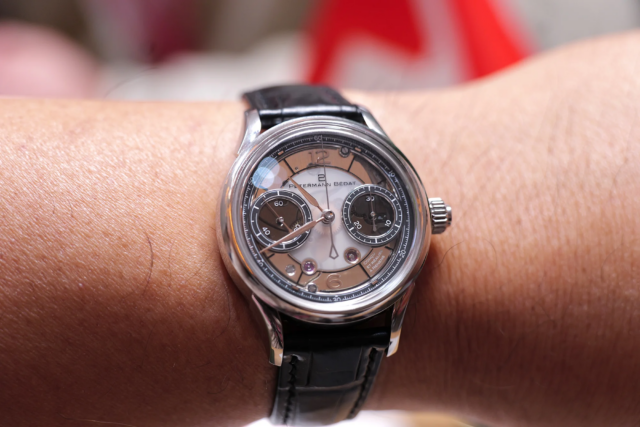
One month after Petermann Bédat won the Chronograph Prize at the 2023 GPHG with its Reference 2941 Split-Seconds Chronograph, the Watchonista team visited the independent watchmaker’s workshop. During that visit, founders Gaël Petermann and Florian Bédat shared their plans for a simpler chronograph based on the award-winning 2941, with a release targeted for 2027.
Fast forward to November 2026, and the new Reference 2914 Monopusher Chronograph debuts at IAMWATCH, hosted by The Hour Glass in Singapore. Having caught a glimpse of a mockup last year, I was eager to see the working prototype in person. For me, the 2914 was one of the event’s most anticipated releases, and it certainly did not disappoint.

At the Petermann Bédat booth, I met with Gaël and team member Joël, who walked me through the new creation. (Florian was unable to attend due to the birth of his daughter. Congratulations to him and his family!)
Here are my first impressions of the Reference 2914 Monopusher Chronograph.
Slimmer Dimensions
The Reference 2941 takes its name from 2941 T.A., the fictional year in which Smaug met his end in J.R.R. Tolkien’s The Hobbit. The new 2914 has a different naming story that was inspired by two vintage Patek Philippe chronographs.
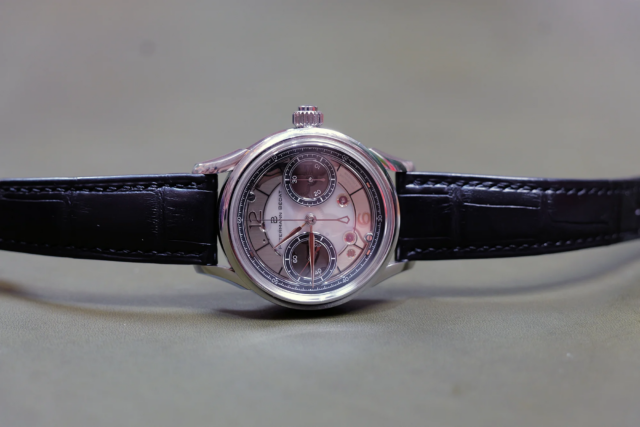
One watch Gaël and Florian particularly admire is the Patek Philippe Reference 1436, a split-seconds chronograph introduced in 1938. Two years later, Patek Philippe introduced the Reference 1463, a conventional chronograph. The reversal of the last two digits of the Patek reference numbers inspired Gaël and Florian to follow a similar approach, naming their new chronograph Reference 2914 after the 2941.
The most noticeable difference between the two Petermann Bédat chronographs is their size. The new 2914 measures just 36.5mm in diameter and 11.6mm thick, compared to the 2941’s 38.6mm diameter and 13.7mm thickness. The reduction in both dimensions gives the new chronograph a noticeably slimmer and more compact profile.
Interestingly, the movements inside the 2941 and 2914 share the same 30mm diameter. The difference in case size is therefore largely a design choice.
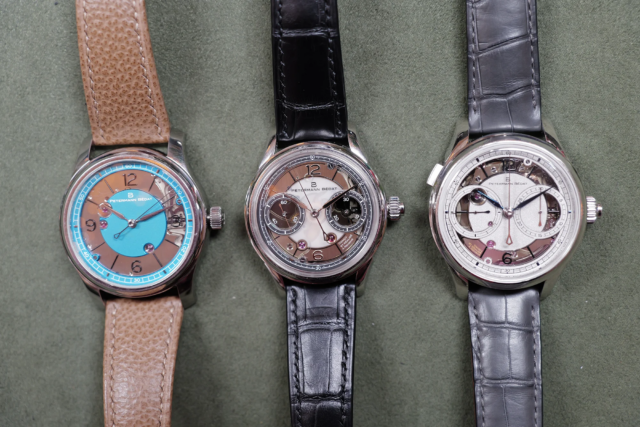
Both founders have a deep appreciation for vintage watches, shaped by their experience restoring antique timepieces. With the 2914, Gaël and Florian finally had an opportunity to create a chronograph in the compact dimensions they personally love. I’m glad they followed their own preferences.
A New Dial Aesthetic
Beyond the smaller case, the 2914 introduces a more colorful dial with stronger contrast, introducing Petermann Bédat’s own interpretation of the classic “panda” dial.
The new design retains the semi-open architecture that has become a signature of the brand, revealing even more of the gears beneath the transparent dial surfaces. Another notable change is the hour markers. While previous models featured markers printed directly onto sapphire discs, the 2914 uses applied gold indices on sapphire, adding more depth to the dial.
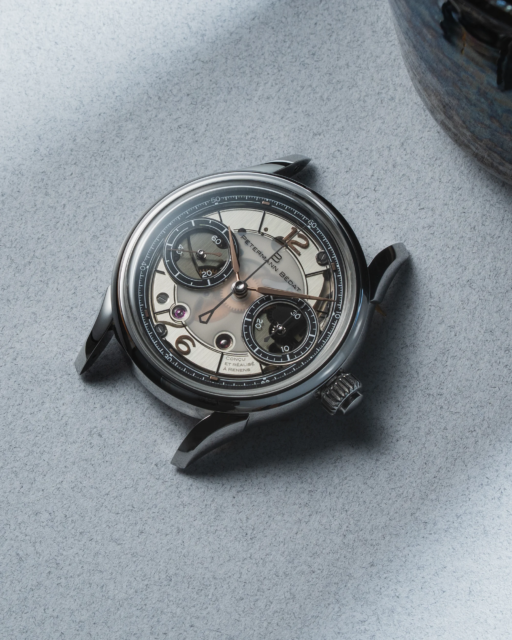
I particularly like how the new dial combines a modern, more expressive look with Petermann Bédat’s established design language. It feels fresh and different, yet remains unmistakably on-brand.
A Stunning Movement
Both a prototype of the 2914 and a production piece of the 2941 were available at the Petermann Bédat booth for IAMWATCH attendees to compare and try on, and at first glance, the two movements looked remarkably similar, with their large balance wheels, polished bridges, and gleaming jewels. This is hardly surprising, as the new movement is derived from the 2941, and both operate at 18,000 vibrations per hour.
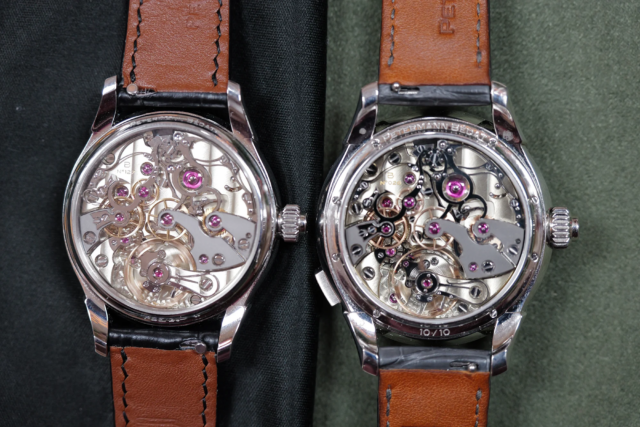
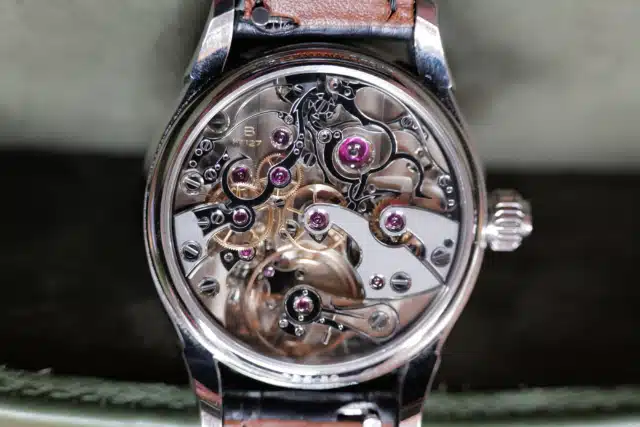
However, Gaël walked me through several notable differences between the two movements. The 2914 adopts the upgraded gear train found in the Reference 1825 for improved reliability. All the wheels are made of gold, and the power reserve has been increased to 56 hours. The split-seconds mechanism has been removed, while the reset mechanism and column-wheel hook have been improved.
The exceptional movement finishing, a hallmark of Petermann Bédat, is once again on full display. Highlights include black-polished bridges and components, hand-polished bevels, and the use of German silver.
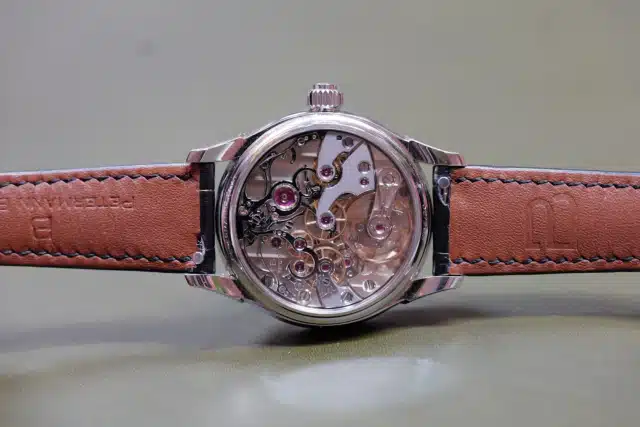
The 2914 is a monopusher chronograph with an instantaneous minute counter. Operating the chronograph is remarkably smooth and satisfying, reminding me of the A. Lange & Söhne 1815 Chronograph.
Again, this is not very surprising, as both founders worked at Lange, with Gaël having worked directly on the 1815 Chronograph, so they know firsthand what makes a great chronograph. With the 2914, they have delivered an experience that is every bit as satisfying, if not more so.
Price and Future Plans
The initial production run of the Reference 2914 is limited to 20 pieces in platinum, priced at CHF 180,000 before taxes. Most will be sold through the brand’s retail partners.
Production of these 20 pieces is expected to take two to three years. A second batch of 20 pieces will retain the 36.5mm case, possibly in a different material. Subsequent production may increase in volume and could introduce a larger case size, potentially around 38mm.
For more information, visit the official Petermann Bédat website.
Advertisement
Your Opinion Needed!
Would you buy this watch?
0 votes