What’s Up with Waltham?




In-depth
What’s Up with Waltham?
Today, we’re looking at what’s behind the revival of the historic American watchmaker.

Earlier this year, Watchonista published an article about five historic watch brands we would like to see revived. Because two of those marques (Elgin and Gruen) were American, we touched briefly on the glory days of good ol’ Yankee watchmaking.
But there’s another “Made in the USA” manufacturer that we didn’t include – Waltham.
If you are into horology, there’s a good chance your friends and family have sent you photos of their grandparents’ timepieces asking for more information about their origins. If this happens a lot, there’s a good chance they’ve asked you to ID a vintage Waltham.
So why, then, did we leave it off our list? Because the company is still ticking away.
Like fellow originally all-American brand Hamilton, Waltham is based in Switzerland now. In fact, for at least a decade, it has been putting out striking watches based on models from its archives. And present-day collectors have been taking note.
Today, let’s dive into Waltham’s past and present.
Born in the USA
Mass production is the USA’s biggest contribution to global watchmaking. Some of the biggest advances in precision timekeeping came from pioneering American industrialists like Florentine Ariosto Jones, founder of the International Watch Company.
Jones traveled from Boston to Schaffhausen to study Swiss craftsmanship, but he also showed locals how to harness hydropower to bring industrialization and mass production to Europe.
New concepts, like shift work, telegraphs, and railroads, meant that factory workers and owners needed to be on time. Moreover, mass production brought with it a standardization of watch parts.
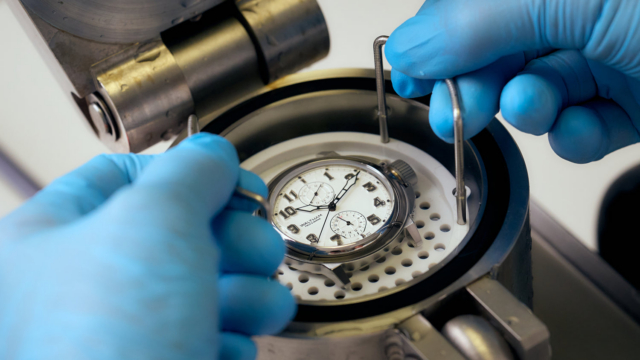
Factories in the Industrial Revolution era developed machinery that cut and finished watch components to interchangeable tolerances, which lowered costs and increased volume so more people could get their hands on a pocket watch.
As a result, 19th-century American watchmaking, pioneered by brands such as Waltham, emerged as a global leader in precision manufacturing.
Waltham’s Origins
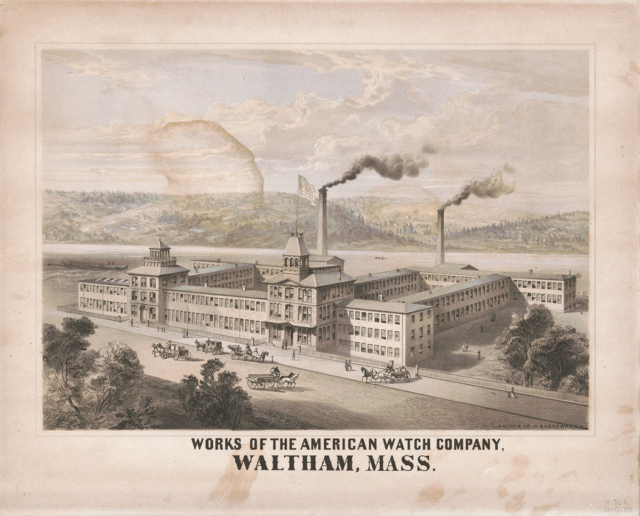
The Waltham Watch Company was founded in 1850 as the Boston Watch Company. Fun Fact: The idea for the Waltham Watch Company came from watchmaker Aaron Lufkin Dennison (whose name lives on in the current-day Dennison) to set new standards for efficiency and accuracy by using interchangeable parts.
Companies like Waltham dominated the railroad and civilian markets with rugged, dependable railway watches well into the early 1900s. Its signature railway grade was the Model 1857.
By the time the railroads standardized time in 1893, Waltham was already the default supplier of precision movements for the entire American industrial economy. In fact, by the time Waltham shut down US production in 1957, it had produced roughly 40 million watches.
For a collector, that scale means two things: plentiful supply at the low end, and genuinely rare top-tier movements at the high end. Most of the Walthams you’ll see at a vintage store or estate sale are gentleman’s dress watches, lovely, historically real, often under $500.
Waltham’s Glory Days
World War I ushered in a whole new era. The horror of trench warfare required a new kind of ruggedness, and pocket watches weren’t as practical as wristwatches on the front lines. Once again, Waltham was quick to adjust to 20th-century needs.
Launched in July 1918, just a few months before Armistice Day, and made to survive the insufferable hardships of life in World War I trench warfare, the “D-D” Field and Marine Watch was billed as the world’s first mass-produced waterproof watch.
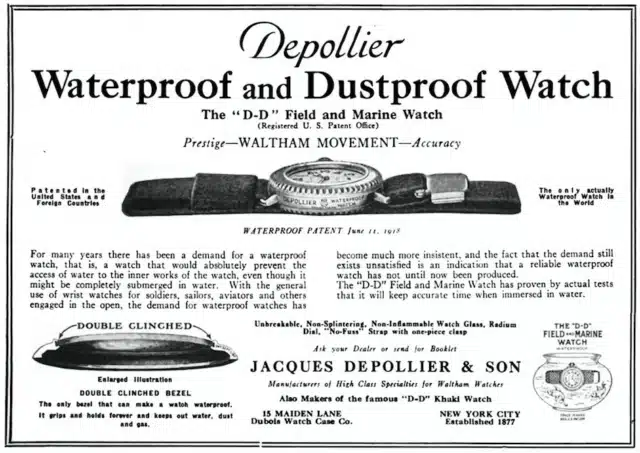
This timepiece was the brainchild of an American named Charles Depollier. He set out to create the perfect military wristwatch case using Waltham movements; the result was a threaded nickel case with a black Japanned finish. Its threaded case with coin edging and screwdown crown set the stage for every dive watch that followed. Still, Depollier and Waltham kept making improvements.
The second generation of the Field and Marine introduced two grooves on the caseback and bezel, plus a “Depollier Chuck Key,” so you could really torque down a hermetic seal. These grooves resemble the gadroons on an Omega Constellation and allowed the key to get the proper torque to seal the watch.
The lacquered, pebble-shaped case also reminds one of the original ceramic Louis Vuitton Monterey, designed by Italian architect Gae Aulenti. In both form and function, the Field and Marine collection was way ahead of its time.
The New Timer
Waltham, like the rest of the American watchmakers, struggled in the years after WWII (the overly simplified reason is that the factories had been retooled for the war effort and never found their footing again in peacetime). So, like many of its US-based peers, Waltham restructured and moved manufacturing to Switzerland.
However, by 1957, Waltham was officially out of business.
Various concerns bought the rights to the Waltham name over the next five decades, until 2011, when American entrepreneur Antonio DiBenedetto became the company’s majority owner.
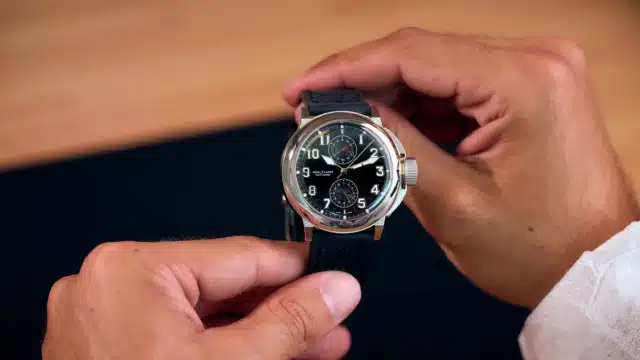
Last month, we met with DiBenedetto and the senior Waltham team to talk about the brand’s rich history and, more importantly, its future. As DiBenedetto explained, he is not just a businessman; he’s also a watch fan, so resurrecting the Waltham name required understanding the brand’s heritage. Therefore, it took some time to tell the story properly.
“Waltham invented the American watchmaking system of mass quality watch production,” says DiBenedetto. “This inspired Henry Ford’s Ford T assembly line and was later adopted by the Swiss watch industry.”
Waltham and industrialization not only helped transform American society (men and women went from working on farms to living in cities in factories), but the affordability of mass-produced watches also helped democratize what was previously viewed as a luxury object.
Another aspect of Waltham that DiBenedetto wants to preserve is its place in pop culture. For instance, he notes that Ford sedans used Waltham-branded speedometers: “Polar explorers Sir Ernest Shackleton (south) and Robert Peary (north) took Waltham pocket watches to the North and South Poles. And aviator Charles Lindbergh carried a Waltham clock in the cockpit of his transatlantic flights.”
That said, DiBenedetto isn’t interested in slapping the Waltham name on random watches or reissuing faithful copies of pieces. Instead, the modern brand has been focusing on making timepieces that honor the legacy, imagining the watches as if they were designed by modern-day Dennisons and Depolliers using today’s advanced mechanisms and materials.
“Waltham is a full-fledged member of the Federation of the Swiss Watch Industry,” says DiBenedetto of the current collection’s bona fides. The company is also committed to modern ways to market the brand. In 2021, for example, Waltham collaborated with Watch Angels to produce a limited edition, automatic version of the Field & Marine.
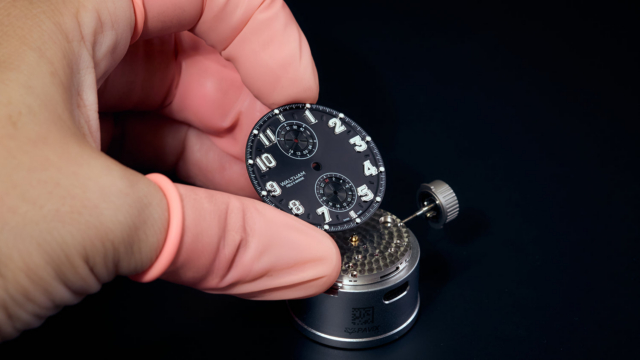
The reception was very encouraging, so the Waltham team has expanded the Field & Marine family to include dual-time watches with bi-compax dials that look and feel incredibly modern.
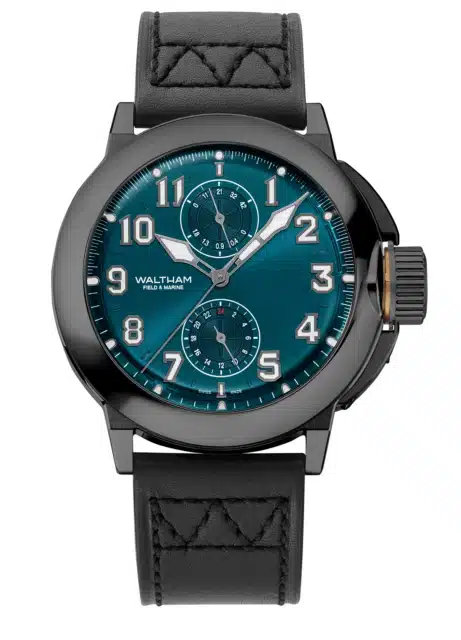
The Field & Marine Dual Time Petrol Blue, with a sunray-finished dial and a 43mm stainless steel case with a gunmetal PVD coating, is particularly forward-looking. Yet it is still a practical diver, with a Depollier bayonet crown system and a two-part compressor-system caseback that gives it 30 ATM water resistance.
Lastly, stay tuned to this space. DiBenedetto is promising more from Waltham in the coming months. We just wanted to give you a head start on picking up pieces from this overlooked brand.
For more information about the brand, check out the Waltham website.