Omega Speedmaster Effect: Three Collectors, Three Distinct Personalities




Collectors Talk, Opinions
Omega Speedmaster Effect: Three Collectors, Three Distinct Personalities
Three collectors reveal how the Omega Speedmaster’s history, design and character can reflect three distinctly different collecting personalities and passions.

Few watches occupy the collective imagination of enthusiasts quite like the Omega Speedmaster. Yet behind the familiar name is an extraordinary range of personalities: from early racing chronographs to space-age tributes and the archetypal Moonwatch.
We look at three collectors – Marco Gabella, Watchinflight and Kristian Haagen – and the Speedmasters they chose, asking what their watches might reveal about the people who wear them.
Marco Gabella: The Pleasure of Knowing Where it Began
Marco Gabella’s Speedmaster is a CK2993 ref. 311.33.40.30.02.001, one of the early references that helped establish the model’s identity before its association with the Moon became its defining story.
The watch pictured here has an immediately compelling combination: a silver dial, contrasting black sub-dials, a black tachymeter bezel and the compact, elegant proportions of a vintage chronograph. It is sporty, certainly, but there is a refinement to the composition that makes it feel almost dressy by contemporary Speedmaster standards.
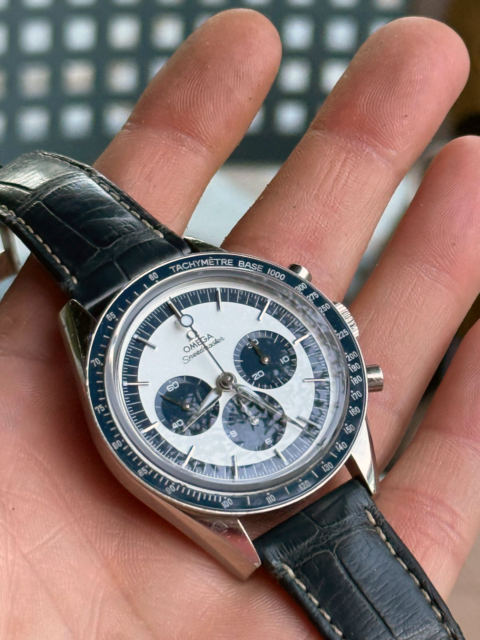
The CK2993 belongs to the period when the Speedmaster was still fundamentally a chronograph for measuring speed. Its story begins on the racetrack, not on the lunar surface. That distinction is important: the watch’s historical significance does not depend on the Apollo programme. It already had a character before history made it famous.
And perhaps that is precisely what makes this choice so revealing. A vintage Speedmaster like this asks its owner to appreciate the model not only as an icon, but as a piece of design that was already successful in its own right. Its appeal is in the details: the dial architecture, the hands, the bezel, the proportions, and the way all of them have survived as a coherent visual language.
Inside the Collector’s Mind
The watch: Confident without being loud. It does not need a large case or a dramatic colour to establish its presence. Its charm lies in balance, contrast, and the feeling that every element is exactly where it should be.
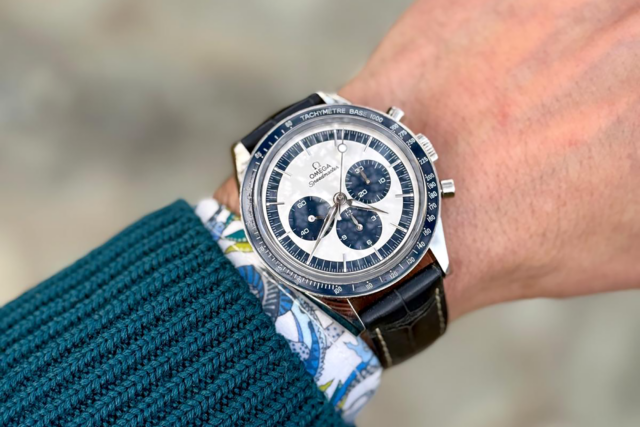
The wearer: Marco’s choice suggests a collector who enjoys the why behind an object as much as the object itself. He is not necessarily looking for the most obvious expression of the Speedmaster; he is interested in the moment when the idea was still taking shape. There is something quietly connoisseurial about that. The watch says: I know the icon, but I also want to know the prehistory.
A final thought: If the modern Moonwatch is the Speedmaster everyone recognises, the CK2993 is the one that reminds you why the story was worth beginning in the first place.
Watchinflight: A Serious Watch With a Mischievous Soul
Watchinflight chose the Omega Speedmaster Silver Snoopy Award 50th Anniversary, reference 310.32.42.50.02.001 – a watch that manages to combine one of the most serious chapters in spaceflight history with one of its most charming characters.
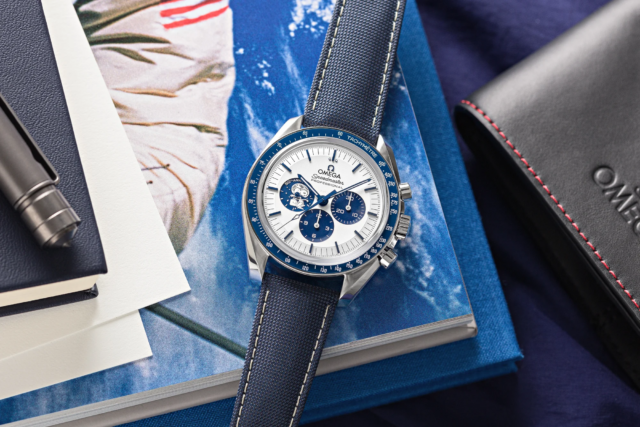
The story behind it is Apollo 13. In 1970, following the explosion of an oxygen tank, the crew faced a life-threatening emergency. The Speedmaster was used to time the critical 14-second engine burn that helped bring the astronauts safely back to Earth. Omega’s Silver Snoopy Award celebrates the brand’s contribution to that achievement, with Snoopy serving as NASA’s symbol of mission safety and excellence.
The 2020 anniversary edition turns that history into something wonderfully theatrical. Its silver-and-blue dial is already distinctive, but the real surprise is on the back: when the chronograph is activated, Snoopy travels around the far side of the Moon while the Earth rotates in the background.
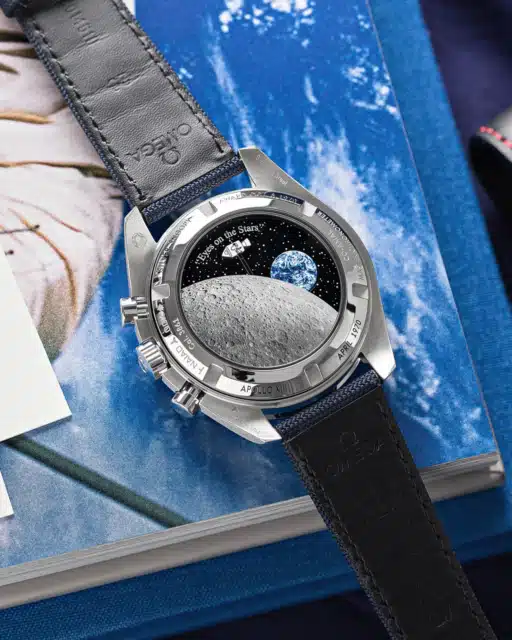
Beneath the storytelling is a thoroughly modern watch, powered by Omega’s calibre 3861, the manually wound Master Chronometer movement also used in the contemporary Moonwatch. The result is a watch that is technically serious, historically meaningful and, crucially, not afraid to be fun.
Inside the Collector’s Mind
The watch: A chronograph with a sense of theatre. It has the credentials of a serious instrument but refuses to behave like a solemn historical monument. Its personality is revealed gradually: first the dial, then the caseback, then the little mechanical performance that makes the whole thing come alive.
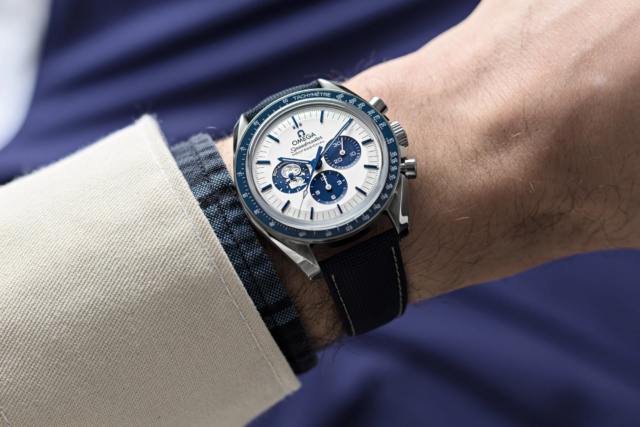
The wearer: Watchinflight’s choice suggests a collector who likes his knowledge to come with a sense of discovery. He appreciates the engineering, but he also understands the pleasure of showing someone something unexpected. It rewards curiosity and, perhaps, a certain generosity and the desire to share the story rather than keep the expertise to oneself.
A final thought: The Snoopy is a reminder that a watch can commemorate an extraordinary technical achievement without losing its capacity to make us smile.
Kristian Haagen: The Icon, Without the Apology
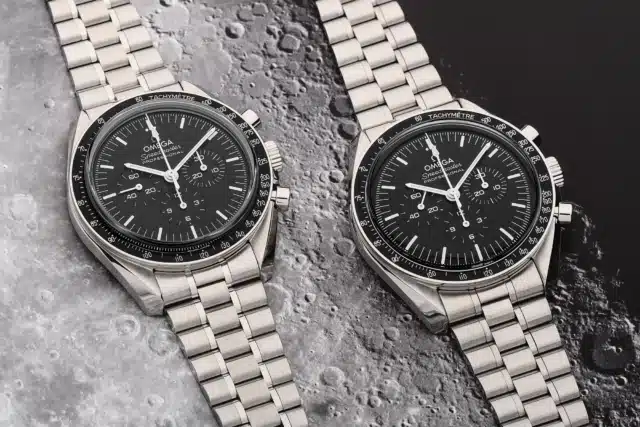
Kristian Haagen’s choice is the Omega Speedmaster Moonwatch Professional, reference 310.30.42.50.01.001. In a discussion about Speedmasters, this is the watch that requires the fewest footnotes – and that may be part of its appeal.
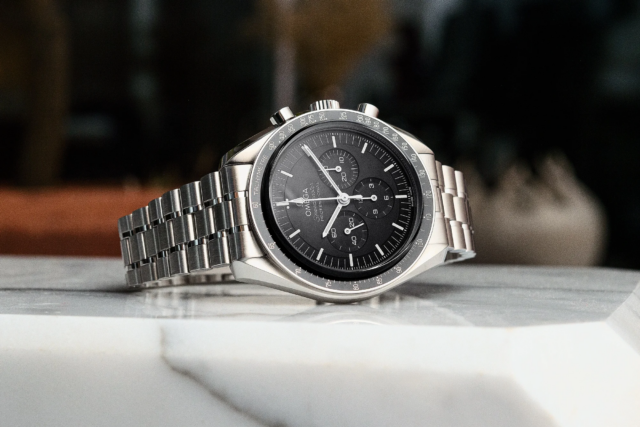
The Hesalite version of the modern Moonwatch is, in many ways, the most direct expression of the model’s identity. It has the familiar 42mm case, black stepped dial, black tachymeter bezel and manually wound calibre 3861. Its acrylic crystal is less resistant to scratching than sapphire, but it retains the material historically associated with the watches worn during the Apollo era.
The current generation, introduced in 2021, brought the 3861 movement, Master Chronometer certification, improved anti-magnetic performance and a redesigned bracelet, while returning several visual details to the model’s historical vocabulary. It is a modern watch that makes a conscious effort not to look overly modern.
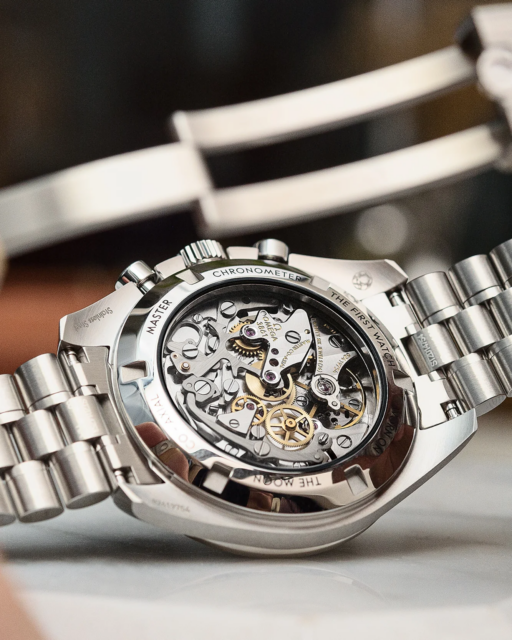
But the Moonwatch’s greatest strength is not that it has remained unchanged. It is that its changes have been made in service of preserving its identity. The watch has accumulated history without becoming burdened by it. It remains a chronograph first, a piece of space history second, and a collecting cliché only if one chooses to see it that way.
Inside the Collector’s Mind
The watch: The Moonwatch is the horological equivalent of a perfectly cut white shirt. Familiar, versatile, and deceptively difficult to improve upon. Its personality is not eccentricity but conviction. It knows what it is.
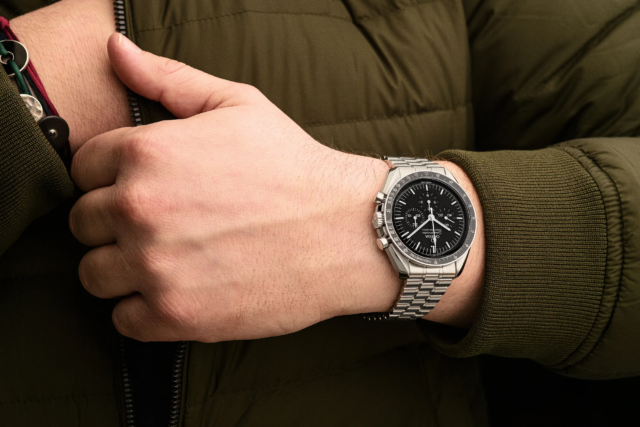
The wearer: Kristian’s choice suggests a collector who does not feel obliged to demonstrate originality at every turn. He can appreciate the obscure and the unusual, but he is equally comfortable acknowledging the power of a definitive object. There is a certain maturity in choosing a classic not because it is the expected answer, but because, after all the looking, it remains the answer that makes sense.
A final thought: The Moonwatch does not need to surprise you. It needs to keep being the Moonwatch – and that is a surprisingly demanding brief.
Advertisement