Milano Watch Week 2026: An Insider’s Verdict on Europe’s Rising Watch Event





A Closer Look, Opinions
Manic Fixie Watches: A Love Letter to Fixed Lug Timepieces
Fed up with flyaway spring bars? Tired of traditional straps and bracelets? Then a fixed-lug watch may be for you.

The fixed lug is one of the most important developments in watchmaking history. The earliest wristwatches from the late-19th and early-20th centuries almost exclusively featured bars that were integrated into the case. This innovation made it possible to attach a strap or bracelet directly to the case.
The fixed bar offers many advantages, including greater structural integrity and a lower risk of a strap or bracelet breaking away. Still, spring bars eventually surpassed fixies in popularity, as it is easier to switch out straps with springies. But what fixed lugs lack in convenience, they make up for with a more streamlined, cohesive design.
And the brands know it! Recently, some of the buzziest launches of late are lugless. So, let’s look at our favorite modern models.
The Blancpain Lady B
We’ve established that the first wristwatches feature fixed lugs. What we didn’t say is that the first wristwatches were made for women. So we’re happy Blancpain, a brand with a deep appreciation for female collectors, recently released the Lady B, which has resurrected the idea of a lugless cocktail watch with interchangeable leather pass-through straps.
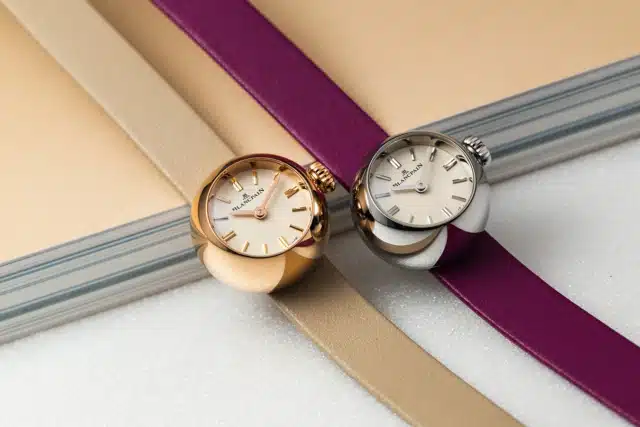
In the mid-20th century, this concept was quite popular. In the 1950s, for example, Rolex offered the Chameleon, which came with a whole wardrobe of different colored straps. The Lady B is based on Blancpain’s Bullet from 1956, whose strap threaded through a slot in the back of the watch, allowing it to be changed in seconds.
And while spring bars, in general, offer greater convenience and flexibility, we can’t think of an easier system for swapping straps than the Lady B’s because it pulls through the caseback; it doesn’t even add extra bulk in the back.
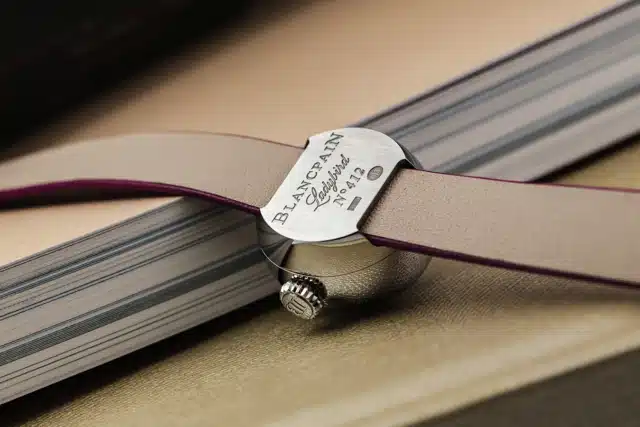
This new interpretation of the bubble-shaped Bullet has proven more versatile than expected, with collectors buying two watches to wear on one strap to create a super-luxe version of a dual-time watch.
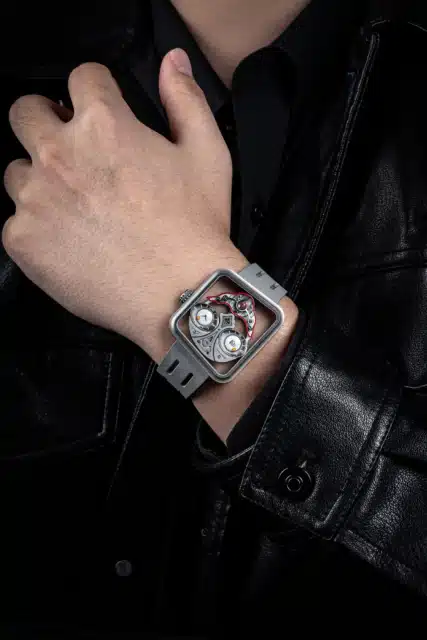
The Donut Watch Company Glazed
Announced in September, the Donut Watch Company – a spinoff of Ming – launched with a not-for-purchase timepiece called the Glazed. While we don’t know when these playful timepieces will be released or how much they will cost, one thing is certain: they have fixed lugs.

The Donut Watch Company shares a few structural similarities with Ming’s sci-fi aesthetic – specifically the brand’s “Flying Blade” flared lugs. But by making those lugs fixed, the Glazed reflects the priorities and constraints of horological history without looking retro.
The decision to go lugless has another visual impact: these watches require open-ended straps, pass-through NATO/Zulu straps, or Bund straps that can wrap around fixed wire lugs without standard removable spring bars. Open-ended straps can be a bit of a hassle to change up. And Bunds and Natos usually make the watch sit higher on the wrist.

But as the name implies, the Glazed is not meant to be super skinny. To balance out the nearly 12mm height of the 35mm-wide, polished steel case, the Glazed comes on a supple grey 18mm NATO-style strap. And despite the Ming connection, these choices give the Glazed its own unique flavor.
The Delhi Watch Company Terra
The Donut Watch Company Glazed looks a bit like a UFO, but the Delhi Watch Company’s inspiration for the Terra is much more down-to-earth.
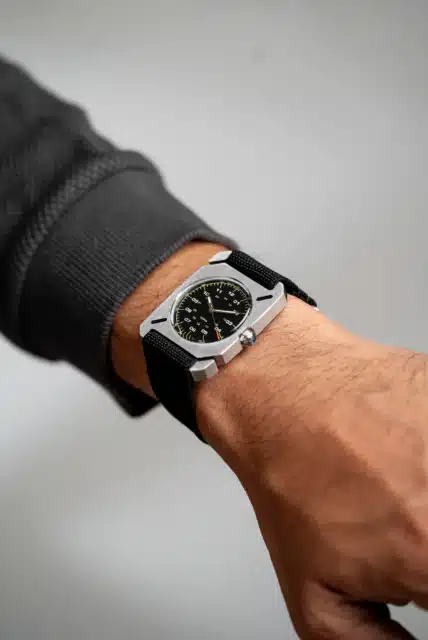
Launched earlier this year to celebrate the Indian watchmaker’s 5th year in business, this unique field watch resembles a carabiner, a functional tool used by mountain climbers and adventurers. And this unusual muse has resulted in the Terra becoming an immediate viral sensation.
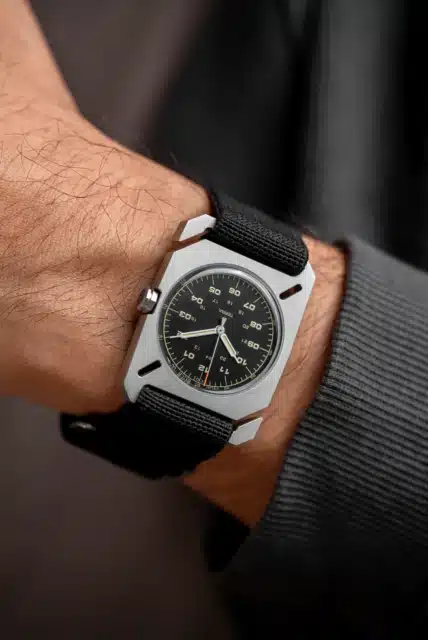
Because field watches have a military origin story, they tend to stick to standard specifications, with fixed lugs often the norm. Of course, the Terra’s dial keeps the classic field-watch legibility; it’s only the case that goes deep into left field.
For starters, the Terra is rectangular. In fact, outside the dial, there’s not a speck of curvature to be found on this 32mm-wide by 44mm-tall case. Instead of lugs, the case features geometric, carabiner-style cuts. It comes with a stretchy black 22mm parachute-style strap with a hook closure that hooks onto the ends, but it also accommodates pass-through straps or looped-end “Marine Nationale” and paratrooper-style bands.
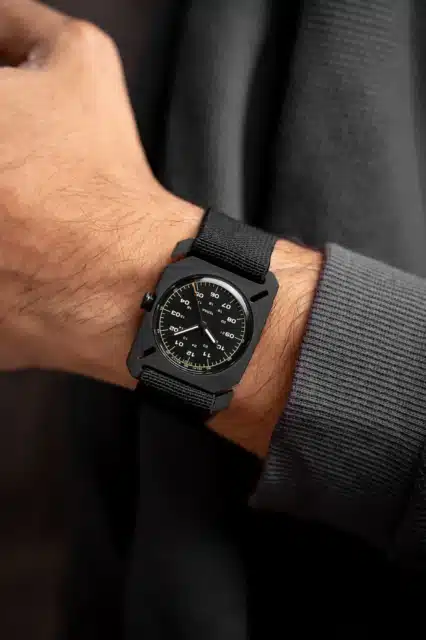
In a case of function following form, I’ve even seen images of some of the folks lucky enough to get the first batch of this limited-production timepiece hooking them onto backpack straps. Another reason the Terra went viral is that it is incredibly affordable – under $50 Yankee dollars! As a result, it is currently sold out, but look for a restock sometime in 2026.
The Tudor Pelagos FXD Marine Nationale
While the Pelagos FXD Marine Nationale isn’t a recent release, it is an important one for the fixed-lug revival. That is because military-issued watches, like this one, were designed to withstand extreme conditions.
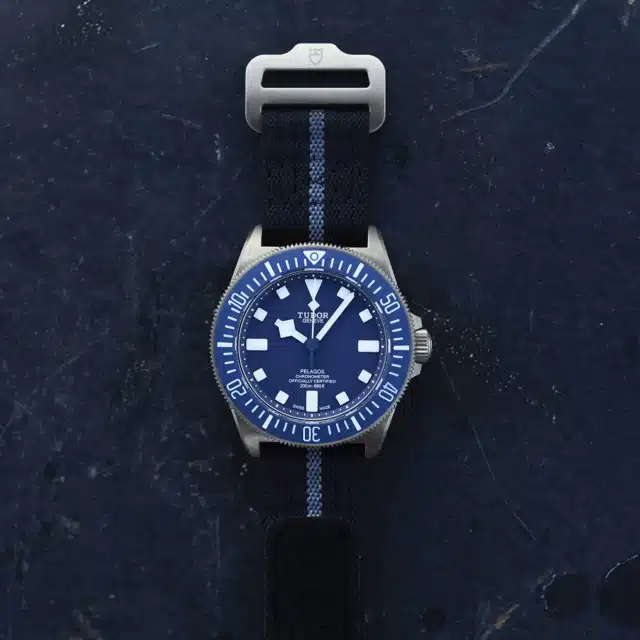
Watches from World War II, such as those used by the British Army and other Allied forces, frequently featured fixed bars. These watches were storied for their ability to withstand extreme conditions. Tudor itself has a rich history of working with the French Navy, or Marine Nationale, and released the Pelagos FXD in late 2021 to underline this heritage. However, this time the partnership was explored as a modern, function-forward tool watch, built to spec for a niche group of divers in the French Navy.
This Pelagos family (FXD is short for Fixed) has cemented its place in the hearts of many because its and that is their commitment to the fixed-lug formula across the entire collection, lending it a slightly quirky take on the dive watch.

To make it even more visually interesting, the most recent addition to the FXD family – the Pelagos FXD GMT “Zulu Time” – was designed to meet the specs of the Aéronautique Navale (French Naval Aviation), the force responsible for naval aviation, and comes on a Flight-suit green one-piece fabric strap with a grade 2 titanium pin buckle and keeper.
The Bertucci Field Watch DX3 Glow
We’ve talked about how the architecture of fixed lugs makes a watch stand out, but advances in materials also make this case design even more useful. Machined from a solid block of a special luminous resin material, the Bertucci Field Watch DX3 Glow bills itself as a watch you will never lose.
This is partly because the case and strap can emit a continuous glow for hours, but also because its Unibody construction results in a very strong, highly water-resistant tool watch that is unlikely to pop off your wrist while in use. Structurally, fixed lugs make sense with plastic watches because resin isn’t fighting with metal spring bars.
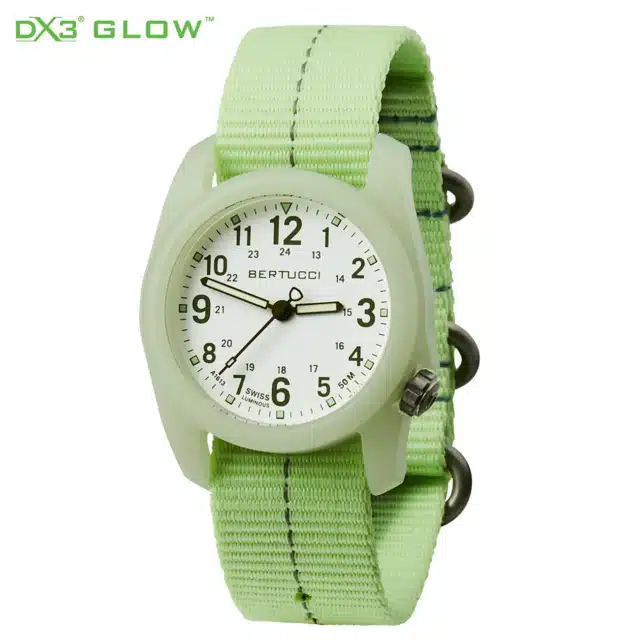
Aesthetically, the material allows Bertucci to have fun with the look of its Field Watch. The DX3 Glow features a patented Unibody, or two-part, 40mm case made of a lightweight resin material. Most watch cases feature three parts, but fewer parts mean more water and dust resistance.
Lastly, as mentioned, the case glows continuously for hours based on its level of light exposure, but it also comes with an Active-Comfort B-Type Dash Line pull-through nylon band that also glows in the dark.
Advertisement