Jacob & Co.’s Arlequino: A Gemologist’s Take on Diamonds in Motion




A Closer Look
Jacob & Co.’s Arlequino: A Gemologist’s Take on Diamonds in Motion
The headline innovation is clear: Jacob & Co. has placed 54 brilliant-cut diamonds on the balance wheel, something the brand describes as a first in modern watchmaking. Yet the question I kept returning to was not only how it was achieved, but why this collection and this quiet pastel palette were chosen as its stage.

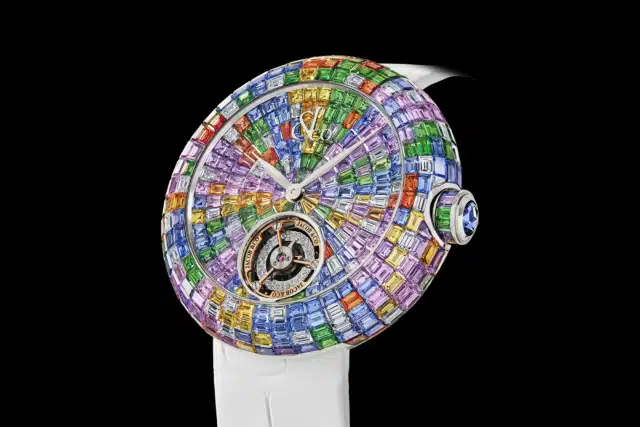
The balance wheel is one of the movement’s most sensitive organs. Adding diamonds alters its mass distribution and moment of inertia. Jacob & Co. does not disclose how many hours, calculations or trials were required, but distributing and securing 54 stones on a component oscillating at 3 Hz, without disturbing its rate stability, suggests an exceptional meeting of jewelry craftsmanship and mathematical precision.
The specification sheet lists an approximate carat weight for every other diamond group, on the case, crown, dial and bridges, except this one. Their size and weight remain the one figure the Maison keeps to itself as a secret ingredient.
The diamonds were not added merely as proof of concept. As the balance oscillates and the flying tourbillon rotates, they create a moving halo, where ornament and chronometric science occupy the same point.
Watchmakers experimented with diamond-set balance wheels in the 1820s and 1830s, when larger deviations were still acceptable, but the idea disappeared as chronometric standards tightened. Jacob & Co. has brought it back under modern expectations of precision.
Why, then, Pastel Arlequino?
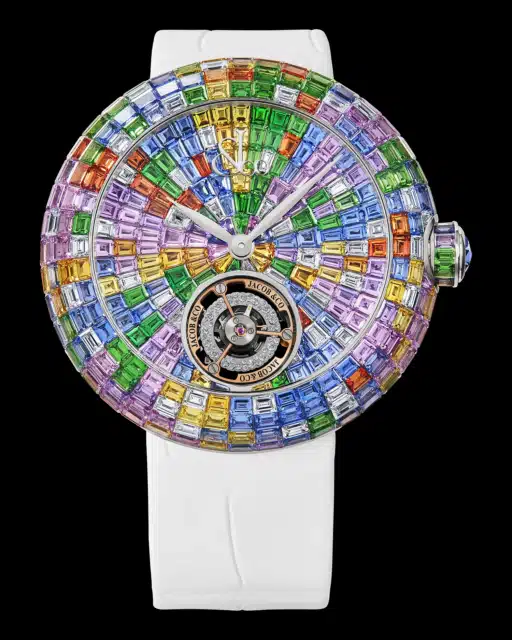
Across the Brilliant Flying Tourbillon collection launched in 2017, colour can form a single saturated field or flow through a rainbow. Arlequino follows another logic. Colours do not blend into a predictable gradient, but they repeat and contrast, producing rhythm and character.
The original Arlequino is intensely coloured and almost theatrical, a piece I find easier to admire than to wear. Its pastel successor feels calmer and, to my eye, more elegant. The case has also been reduced from 47 to 42 mm, sharpening focus on the diamond-set balance wheel.
Its apparent complexity is materially coherent: the entire colour vocabulary is drawn from natural sapphire, revealing the extraordinary spectrum of a single mineral – corundum.
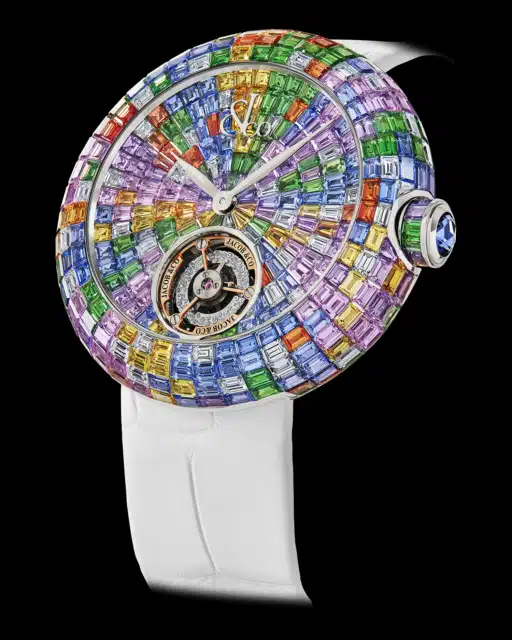
Pastel places real demands on a stone: the soft colour and open tables of step cuts leave nowhere to hide, and clarity, tone and saturation are visible at a glance. Pastel forgives nothing. The sapphires themselves carry no rarity premium: pale saturation, unlike the deep tones of their premium counterparts, is simply a lighter position within that same mineral’s range. The real difficulty lies in sourcing stones untouched by heat treatment in a market flooded with enhanced goods, then calibrating them, hue by hue, into one coherent surface – work with no market rate, guided by the eye rather than carat weight.
The baguette diamonds are, by default, of the highest quality, but their role here is mechanical rather than singular: small fixed points of light that set the sapphire kaleidoscope in motion. That same discipline governs the cut: straight baguettes meet calibrated trapezoidal sapphires, each stone shaped for its exact position along the radius. Because invisible setting hides the metal beneath, the smallest error in proportion would break the surface.
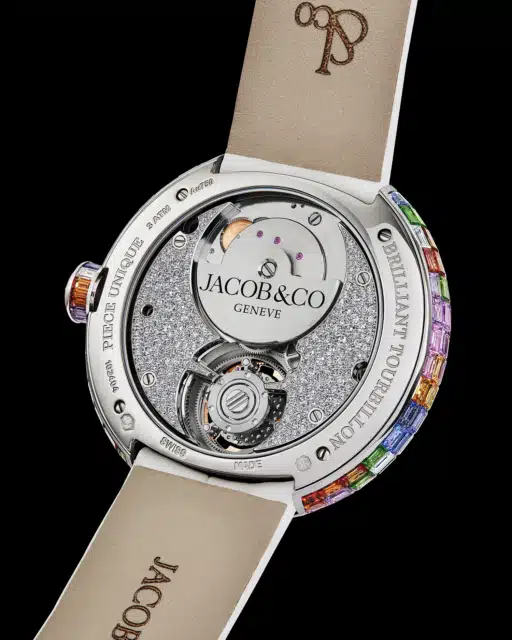
The jewelry language continues through the sapphire caseback, where the movement’s bridges are pavé-set with 234 brilliant-cut diamonds, yet the front marks a decisive step forward: stones no longer decorate the movement; they enter its regulating organ. Even if the price is publicly announced ($693’000), the real currency here is hours of trial, the one figure that the Maison already withholds from its specification sheet.
Pastel Arlequino wears its order lightly. Colour, geometry, setting and weight are held to the same tolerance as the movement they surround, discipline disguised as spontaneity.
Looking Ahead
Pastel Arlequino treats a stone’s geometry as engineering. The same logic continues in Jacob & Co.’s Billionaire Double Tourbillon Angel-Cut Diamonds, nominated in the Jewellery category at the 2026 GPHG, the industry’s most closely watched award.
Its patented 37-facet cut reworks how a rectangular stone returns light. What will be most revealing is seeing it beside the baguettes on the same watch, under the same light.
For more information, please visit Jacob & Co.’ website
Advertisement